The “Draft Barron Trump” website did not emerge out of nowhere. It surfaced suddenly at a moment when global tensions were already running high. Reports of U.S. and Israeli airstrikes targeting Iranian facilities had reignited familiar fears about another prolonged conflict in the Middle East—one that many Americans worry could spiral into yet another generation defined by war.
Into that tense atmosphere stepped a provocative piece of political satire.
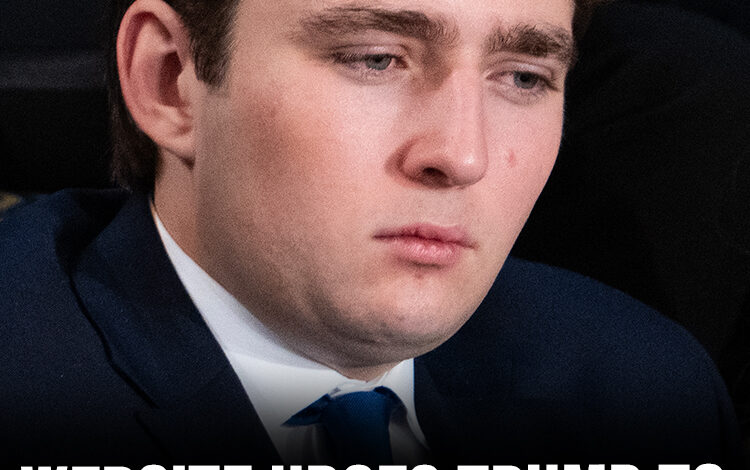
The website, created by Toby Morton, a writer formerly associated with South Park, used dark humor and exaggerated rhetoric to raise a pointed question about power and accountability. By invoking Barron Trump, the youngest son of former President Donald Trump, Morton’s project attempted to challenge a long-standing dynamic in politics: the tendency for leaders and influential figures to speak confidently about military strength while the risks are carried primarily by ordinary families.
The site’s deliberately over-the-top language praised Barron as possessing “proven genes” and “inherited courage,” echoing the kind of heroic framing often used around political families and national leadership. But the tone was unmistakably satirical. Its real purpose was to highlight what the creator viewed as the contradiction between political rhetoric about sacrifice and the reality of who typically bears the cost of war.
In essence, the message behind the satire was blunt: if influential figures advocate aggressive military action, should their own families also share in that burden?
Online, the phrase #SendBarron quickly spread across social media. For some participants, the hashtag became less about the individual teenager himself and more about a broader criticism of political culture. Many commenters used it to express frustration with what they see as a pattern in American history—leaders making decisions about war while remaining personally distant from its consequences.
Critics of U.S. military intervention argued that families across the country have repeatedly sent their sons and daughters into combat while the political class remains insulated from those risks. In that sense, the viral slogan was interpreted by supporters as a symbolic challenge to the perceived imbalance between those who decide on war and those who must fight it.
However, the campaign also sparked significant backlash.
Many people felt that involving Barron Trump, who is still a teenager, crossed a moral boundary regardless of the political message. Even individuals who agreed with the broader criticism of war argued that minors should not be dragged into political disputes or used as targets of public commentary.
That disagreement quickly turned the controversy into a debate about ethics as much as politics. Some defended the satire as a long tradition in American political discourse—one meant to provoke uncomfortable reflection. Others insisted that satire should never come at the expense of a young person who has no role in shaping government policy.
The fierce reaction revealed something deeper than the original joke.
Behind the arguments was a growing sense of fatigue among many Americans who feel that decisions about war are too often made far from the people who will ultimately carry them out. Decades of military involvement abroad have left large parts of the public wary of new conflicts and skeptical of political messaging that frames war in heroic or abstract terms.
For supporters of the satire, the controversy served as a way to force a difficult conversation into the public sphere—one about responsibility, sacrifice, and the gap between rhetoric and reality.
For critics, it showed how quickly political discourse can become personal and how easily the boundaries of respectful debate can be pushed aside in the age of viral content.
Either way, the uproar surrounding the “Draft Barron Trump” website illustrated how powerful satire can still be in shaping public discussion. Whether people saw it as a legitimate critique or an inappropriate attack, the conversation it sparked reflected a broader unease about war, leadership, and who ultimately pays the price when nations choose to fight.
And in a time when political debates often feel locked in partisan stalemates, satire—sharp, uncomfortable, and controversial—remains one of the few tools capable of breaking through the noise and forcing people to confront those questions directly.