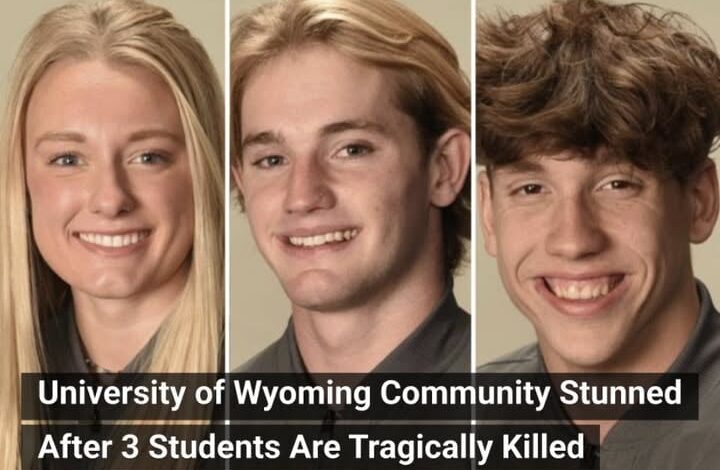
What began as an ordinary afternoon ended in a moment that would fracture lives, futures, and an entire community. Charlie Clark was just 19, known among his teammates for the calm focus that defined him in the water. Years of early mornings, quiet determination, and the steady rhythm of training had shaped him into the kind of athlete coaches trusted and teammates admired. Luke Slabber, 21, had traveled thousands of miles from Cape Town with the hope of building something bigger than himself. Leaving home behind, he carried the ambition that draws so many young athletes across oceans—the belief that dedication and sacrifice might open doors to opportunity. Carson Muir, only 18, was still at the very beginning of her college life, adjusting to classes, teammates, and the strange mixture of excitement and uncertainty that comes with a freshman year far from home.
None of them could have imagined that their stories would end not in competition or graduation, but on a stretch of road in the violent seconds of a crash. In a single roll of a Toyota RAV4, plans that once stretched years into the future were suddenly reduced to the harsh physics of speed, force, and metal meeting asphalt. The dreams they carried—records to break, degrees to earn, families to make proud—vanished in an instant that no one present had the power to stop.
For the two teammates who survived, the world they stepped back into would never resemble the one they had left earlier that day. When they walked out of the hospital, it was not simply with injuries that would eventually heal, but with the weight of an experience that will remain with them for the rest of their lives. Survivors of tragedies often describe a strange, quiet shift in reality—how the ordinary details of life suddenly feel unfamiliar, how memories replay endlessly as the mind tries to understand a moment that arrived without warning.
One of those survivors had been behind the wheel. It is a detail that will inevitably draw attention and questions, both from investigators and from the relentless inner voice of someone trying to process what happened. Official reports may analyze tire marks, vehicle dynamics, road conditions, and timelines measured in fractions of seconds. They will attempt to reconstruct the sequence of events through evidence scattered across pavement and through damaged metal. Yet even the most detailed investigation can never fully explain the emotional burden carried by someone who lived through the same moment others did not.
Across the University of Wyoming community, the loss has settled in slowly, like a heavy silence after noise abruptly stops. For a team built around shared effort and constant motion, the absence is impossible to ignore. In the locker room, there are spaces that will remain untouched—lanes in the pool that once echoed with splashes during early morning practices now carry a different weight. Teammates who once competed side by side are now left with memories of conversations, training sessions, and laughter that seemed ordinary at the time but now feel painfully significant.
Coaches, teammates, and friends have begun the difficult process of honoring three lives that ended far too soon. Stories about Charlie’s discipline, Luke’s journey from South Africa, and Carson’s enthusiasm as a new student circulate through campus conversations and quiet gatherings. These memories form a fragile attempt to hold onto the human side of a tragedy that might otherwise be reduced to headlines and statistics.
In moments like this, communities often search for explanations, for something that can make sense of loss that feels senseless. But the reality is that some events resist simple understanding. A crash can be analyzed, timelines reconstructed, and conclusions written into official reports, yet none of those details can restore what was lost.
What remains instead are the ripples of their lives—the teammates they encouraged, the friends they laughed with, the families who watched them chase goals that once seemed limitless. The University of Wyoming community now faces the painful task of continuing forward while carrying the memory of three swimmers whose races ended far earlier than anyone expected.
And somewhere in the quiet spaces of the pool, in the rhythm of laps and the echo of starting blocks, their absence will continue to be felt long after the investigation ends and the headlines fade.