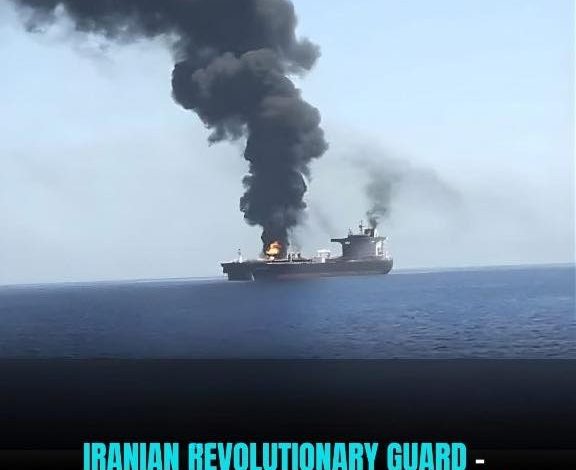
Iran has claimed that its Islamic Revolutionary Guard Corps (IRGC) struck a U.S.-linked oil tanker in the northern Persian Gulf, saying the vessel caught fire after the attack. According to Iranian state messaging, the strike was carried out by naval units as part of a broader military campaign during what Tehran describes as a “time of war.”
What Iran says happened
- The IRGC claims it targeted a tanker linked to the U.S. or its allies, allegedly using drones or other naval weapons.
- Iranian statements say the vessel was hit and left burning in the waters near the Strait of Hormuz, a critical oil transit route.
- Tehran has also warned that U.S., Israeli, European, and allied vessels could be targeted if they attempt to pass through the strait.
Iranian officials have framed the strike as part of retaliation in a widening conflict with the U.S. and Israel and have asserted that Iran will exercise authority over the Strait of Hormuz during wartime.
What is confirmed — and what is not
- Independent confirmation of the tanker’s status remains limited.
- U.S. officials and international maritime monitoring groups have not publicly verified all aspects of Iran’s claims, including whether the ship is still burning or the extent of damage.
- However, maritime safety organizations have reported explosions and vessel incidents in the region around the same time.
Why the Strait of Hormuz matters
The Strait of Hormuz is one of the world’s most important energy chokepoints, carrying roughly 20% of global oil and LNG shipments.
Any attack or threat in this area can have major global consequences:
- Oil prices can spike rapidly due to fears of supply disruptions.
- Commercial shipping may halt or reroute, increasing transport costs worldwide.
- Insurance companies may withdraw coverage for ships operating in the region.
Recent data already shows dramatically reduced ship traffic and multiple tanker incidents linked to the escalating conflict.
The bigger geopolitical context
The incident is unfolding amid a rapidly escalating confrontation between Iran, the United States, and Israel, with strikes, retaliatory attacks, and threats spreading across the region.
Military analysts warn that if attacks on commercial shipping continue or intensify, the situation could:
- expand into a wider naval conflict in the Persian Gulf,
- draw additional international forces into the region, and
- further destabilize global energy markets.
✅ Bottom line: Iran says it struck a U.S.-linked oil tanker and is asserting control over the Strait of Hormuz, but key details—including the condition of the vessel and the full circumstances of the attack—are still being verified by independent sources.
If you want, I can also explain why the Strait of Hormuz is one of the most strategically important waterways on Earth and what could happen globally if it is effectively closed.