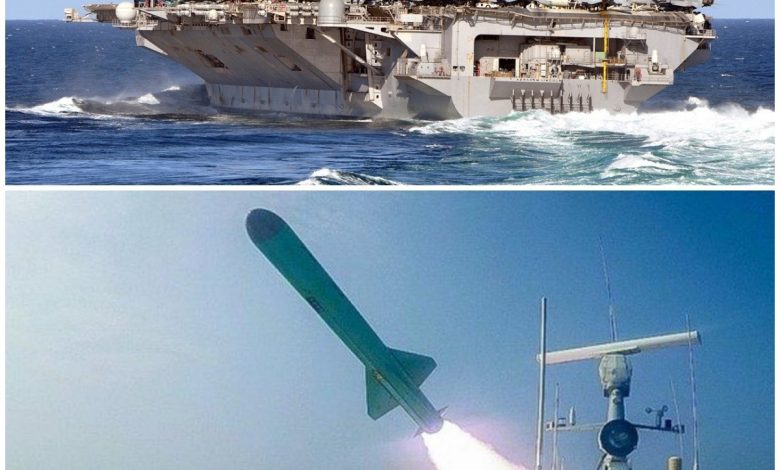
When Iran’s Revolutionary Guard released footage showing a swarm of drones attacking a mock-up of the USS Abraham Lincoln, the symbolism was obvious. The message portrayed inexpensive, mass-produced drones overwhelming a multibillion-dollar aircraft carrier—suggesting that sheer numbers could defeat advanced technology. It was a demonstration aimed not only at domestic audiences but also at U.S. strategists and naval planners monitoring activity in the Persian Gulf.
Yet staged demonstrations rarely reflect the complexity of real combat.
In a genuine confrontation, Iran would likely begin with surveillance and controlled escalation rather than launching a massive strike immediately. Launch sites along the coast near Bandar Abbas could activate sequentially, sending out waves of one-way attack drones similar to the Shahed-136. These drones would follow pre-programmed GPS routes toward a U.S. carrier strike group operating somewhere in or near the Gulf.
Despite their growing reputation, such drones are not highly intelligent systems. They generally depend on satellite navigation and predetermined coordinates. Once launched, they cannot easily adjust their flight path or respond dynamically to electronic warfare. Their effectiveness comes primarily from affordability and the ability to deploy them in large numbers.
Detection, however, would likely occur long before the drones approached visual range.
An E-2D Hawkeye airborne early-warning aircraft flying high above the fleet would probably detect the incoming contacts at significant distance. Its AN/APY-9 radar is designed specifically to identify small, low-altitude targets over cluttered environments like the ocean surface. The information collected by the aircraft would then be distributed across the strike group through Cooperative Engagement Capability (CEC) networks.
In practical terms, that means a destroyer positioned many miles away could launch an interceptor using targeting data gathered by another platform. Instead of operating as independent ships, the carrier strike group functions as a unified, networked combat system.
Initial defensive actions would rely on multiple protective layers. Naval guns firing proximity-fused ammunition can eliminate slow drones at medium ranges. Closer to the ship, systems such as the Phalanx Close-In Weapon System (CIWS) are designed to destroy incoming threats within just a few kilometers. Rolling Airframe Missiles (RAM) and larger interceptors like the SM-2 or SM-6 extend the defensive perimeter much farther.
One criticism often raised about missile defenses is the cost imbalance: interceptors worth millions being used against drones that may cost only tens of thousands of dollars. That economic disparity has influenced much of Iran’s drone strategy. Saturation attacks aim to overwhelm defenses and deplete a fleet’s missile supply.
However, missile inventory is no longer the only factor shaping naval defense.
In recent years, the U.S. Navy has been testing directed-energy technologies—including lasers and high-powered microwave systems—specifically intended to counter large numbers of drones. Unlike traditional weapons, these systems do not rely on physical ammunition. Instead, they draw energy from the ship’s electrical power systems.
High-powered microwave weapons work by flooding electronic components with electromagnetic energy, disrupting circuits and disabling onboard systems. Rather than exploding the drone, the effect often causes its guidance electronics to fail, sending it spiraling out of control.
If deployed widely, such technology could change the economic balance. Instead of using a missile for every drone, a warship might neutralize multiple targets in rapid succession. The main limitations become electrical power output and heat management rather than the number of missiles stored on board.
Still, directed energy is not a universal solution. These systems depend on reliable targeting data, and low-flying drones can be difficult to distinguish from sea clutter on radar. Weather, engagement geometry, and coordination with other defensive systems also introduce constraints. In a battle that might involve ballistic missiles, cruise missiles, drones, and surface threats simultaneously, careful timing and coordination are essential.
For instance, a microwave system cannot differentiate between enemy electronics and friendly systems. If a defensive missile were flying through the same engagement zone at the wrong moment, careful timing would be necessary. The Aegis combat system aboard U.S. warships helps manage this complexity by automatically calculating engagement windows and coordinating weapons systems in fractions of a second.
The most challenging scenario for a fleet would be a combined-arms attack.
Iranian military doctrine emphasizes multi-layered pressure: drones to saturate defenses, anti-ship ballistic missiles to force expensive interceptor launches, and fast attack boats armed with cruise missiles to exploit gaps in the defensive perimeter. The goal is to overload defensive systems and create timing conflicts for commanders.
Against ballistic threats such as the Khalij Fars anti-ship missile, traditional interceptors remain essential. Directed-energy systems cannot replace every layer of defense. Standard Missile interceptors would still be responsible for engaging high-altitude or exo-atmospheric threats before they reach the fleet.
At the same time, helicopters like the MH-60R Seahawk would address surface threats, using precision weapons to disable fast attack craft before they could move into missile launch range.
Managing these different systems becomes a carefully choreographed process. Sensors track incoming threats, algorithms allocate engagement zones, and defensive systems activate in tightly controlled time windows. Human commanders oversee the process, but much of the real-time calculation is handled by automated combat software.
In this environment, the economic equation of drone warfare begins to change.
A swarm intended to overwhelm defenses may instead expose its own infrastructure. Every radar activation, communications signal, or telemetry transmission from a launch site becomes intelligence. Aircraft such as the E-2D Hawkeye can locate these emissions with high precision.
The immediate tactical outcome—how many drones are shot down—may matter less than the intelligence gained during the attack. If the strike group retains most of its missile inventory while identifying the locations of coastal launch sites, the strategic advantage shifts.
This is an often overlooked aspect of modern naval combat: defensive actions also function as intelligence gathering.
Of course, no defense system is perfect. Technical limitations, radar blind spots, environmental interference, and sheer numbers still matter. Adversaries can adapt tactics, alter drone flight profiles, employ electronic warfare, or integrate cyber operations with physical attacks.
Yet the assumption that inexpensive drones will inevitably overwhelm advanced naval forces relies on the idea that defenses remain static. Naval technology and doctrine continue to evolve.
The introduction of operational directed-energy weapons—if deployed widely—represents a major shift in naval strategy. Defensive capacity becomes tied not only to missile inventory but also to electrical power generation. The economic advantage of saturation tactics could diminish as a result.
For Iran, videos of drone swarms striking mock carriers project an image of confidence and capability. For the U.S. Navy, the real response would likely be quieter and far more methodical.
Early detection. Layered defenses. Automated coordination between weapons systems. Selective use of missiles. Directed-energy systems for large numbers of drones. Aviation assets to counter surface threats. And continuous intelligence collection throughout the engagement.
In a real conflict, the most significant result might not be the number of drones destroyed, but the information revealed by the attack itself.
Today’s naval power is defined less by the size of individual ships and more by how effectively sensors, networks, and weapons operate together.
Drone swarms test that integration.
Whether Iran’s strategy remains effective will depend not on a single weapon system, but on how quickly counter-drone technologies and networked defenses continue to evolve.