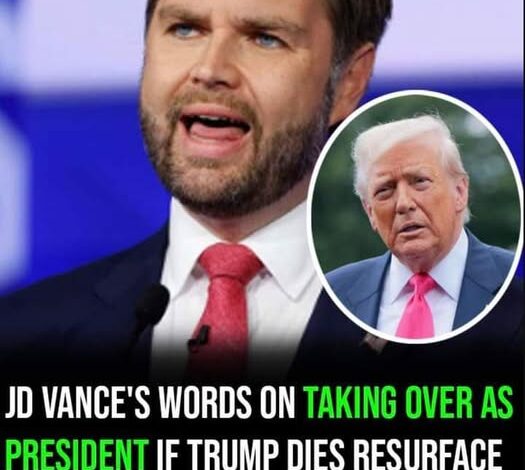
Questions surrounding presidential succession and international security have moved to the forefront of American political discussion following renewed attention to past remarks from Vice President JD Vance. His comments about the constitutional process that would take effect if President Donald Trump were unable to continue in office have resurfaced at a time of heightened geopolitical tension. At the same time, strong warnings from the administration directed at Iran have intensified debate about how domestic leadership dynamics intersect with foreign policy decisions. As 2026 unfolds, the tone of statements coming from the White House suggests a more direct connection between the safety of the presidency and the country’s broader military strategy.
Much of the controversy stems from President Trump’s recent warning aimed at Tehran. In a series of statements addressing potential threats against him, the president declared that any assassination attempt or plot tied to the Iranian government would provoke an overwhelming response from the United States. His language emphasized total retaliation, suggesting that any such attack would lead to severe consequences for Iran’s leadership. For many observers, the statement represents an unusually explicit form of deterrence, linking the personal security of the president to the possibility of major military action.
In this tense environment, Vice President Vance’s earlier comments about presidential succession have taken on new relevance. Vance has consistently presented himself as a stabilizing figure within the administration, emphasizing continuity of policy and leadership should the constitutional line of succession ever come into play. However, the theoretical possibility of a sudden transition during an international crisis has prompted renewed scrutiny of his potential role. Supporters see him as someone capable of maintaining the administration’s core policies, while critics question how such a transition might unfold during a moment of geopolitical instability.
Concerns about presidential security have also grown amid intelligence reports pointing to increased coordination among U.S. adversaries. Some reports have suggested that Russia has shared certain intelligence information with Iran regarding American activities, raising alarm among security officials. These developments have contributed to a broader atmosphere of caution within Washington. Federal security measures in the capital have intensified, with more visible law enforcement and National Guard personnel appearing in key locations across the city.
From a constitutional standpoint, the renewed focus on succession highlights the critical importance of the vice presidency. In modern politics, the selection of a vice president carries significant strategic weight, especially when a sitting president’s leadership style is closely tied to their personal presence and influence. Discussions about succession therefore ripple across the political landscape, as both allies and opponents consider how leadership might evolve if circumstances suddenly changed.
The rhetoric surrounding potential retaliation against Iran has also sparked a broader cultural and political debate. Supporters argue that firm language strengthens deterrence and signals that the United States will respond forcefully to threats against its leadership. Critics, however, warn that such language could increase tensions and create misunderstandings on the international stage. Some analysts believe that the risk of escalation grows when personal threats are tied directly to military policy.
These concerns are amplified by the complex web of international relationships currently shaping global politics. Intelligence officials and foreign policy experts worry that misinterpretations, cyber activity, or intelligence leaks could trigger a chain reaction that neither side intends. In this context, even symbolic statements can carry significant strategic consequences.
Meanwhile, the administration has continued emphasizing the protection of the presidency as a top national priority. This includes both traditional security measures—such as the work of the Secret Service—and modern efforts to safeguard digital communications and infrastructure. Each new report of potential threats reinforces the administration’s message that heightened security measures are necessary.
The debate has also reached Capitol Hill, where lawmakers from both parties are grappling with the broader implications of the administration’s statements. Some members of Congress argue that the president, as commander-in-chief, holds wide authority to respond to threats against national leadership. Others caution that any use of military force should remain subject to established legal checks and congressional oversight.
In this environment, Vice President Vance’s role as a key adviser and interpreter of the administration’s policies has become increasingly visible. He often serves as a bridge between the president’s blunt public statements and the detailed legal or strategic explanations offered by the administration’s policy teams.
Ultimately, the discussion surrounding these issues reflects a deeper question about how power is exercised in the modern world. The United States must balance protecting its leadership and projecting strength while also maintaining stability in an unpredictable global environment. Whether the administration’s warnings serve as a successful deterrent or contribute to rising tensions remains a central question in international politics.
Looking ahead, historians and analysts may view this period as a defining moment in how presidential authority, security concerns, and foreign policy intersect. In an era where political decisions reverberate instantly across the globe, the stakes of leadership choices are extraordinarily high. For many Americans, the hope is that strong rhetoric will ultimately be accompanied by careful diplomacy, ensuring that national security is protected without pushing global tensions toward unnecessary conflict.