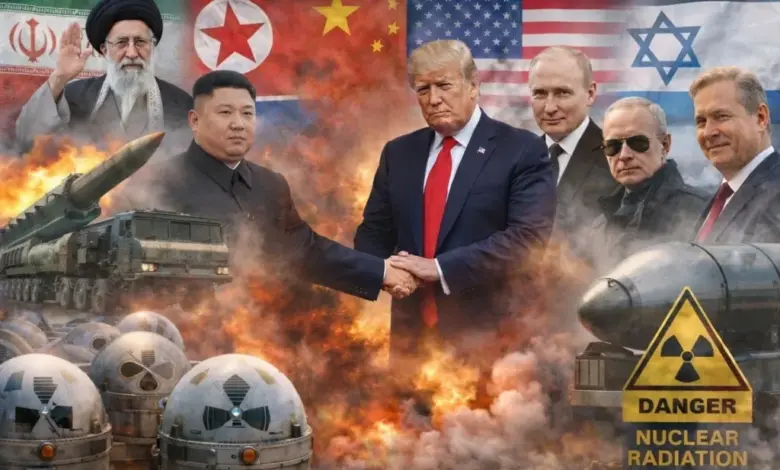
For decades, the Arctic was viewed as a region governed by a delicate balance often described as “high north, low tension.” Recently, however, that fragile stability has begun to erode as the region moves to the forefront of global strategic competition. A new wave of geopolitical anxiety has been sparked by renewed discussion surrounding Greenland—an autonomous territory within the Kingdom of Denmark that has unexpectedly become central to President Donald Trump’s strategic outlook. Trump has framed stronger U.S. involvement with Greenland as a matter of national security, a stance that has triggered unusually sharp reactions from Moscow. Russian officials have escalated their rhetoric from diplomatic criticism to dramatic warnings, with one senior lawmaker claiming that aggressive U.S. ambitions regarding Greenland could lead to “the end of the world.” Although the language is clearly exaggerated, it reflects a deeper shift in perception: the Arctic is increasingly viewed not as an isolated wilderness but as a potential arena for confrontation among major powers.
The growing importance of Greenland is rooted in a combination of geography, environmental change, and modern military capabilities. Positioned between North America and Europe, Greenland occupies a strategic location in the Northern Hemisphere. For many years, the United States has maintained a military presence there through the Pituffik Space Base—formerly known as Thule Air Base—which plays a crucial role in the American missile warning network. The base hosts radar systems that monitor potential ballistic missile launches and contribute to the broader Integrated Tactical Warning and Attack Assessment system. As Russia continues to modernize its Northern Fleet and develop advanced weapons such as hypersonic missiles, the strategic significance of these early-warning installations has grown considerably. Advocates of greater U.S. control over Greenland argue that in an era defined by renewed great-power competition, Washington cannot afford uncertainty over such a critical defensive position.
At the same time, the Arctic itself is undergoing dramatic environmental transformation. Rising global temperatures are accelerating the melting of polar ice, gradually opening new maritime routes across the Arctic Ocean. These emerging shipping corridors could eventually rival traditional trade pathways like the Suez Canal or the Panama Canal. Beyond transportation, the region is believed to contain large reserves of natural resources, including rare earth minerals, oil, and natural gas. For Russia in particular, the Arctic represents a central pillar of both its economic future and national security. The country possesses the longest Arctic coastline in the world and has spent years revitalizing former Soviet-era bases while expanding its fleet of icebreakers—far surpassing the capabilities currently available to Western nations. From Moscow’s perspective, any attempt by the United States to dramatically alter Greenland’s status is seen as a strategic threat to the regional balance of power. The stark warnings from Russian lawmakers refer to concerns that an expanded U.S. missile-defense network across the Arctic could undermine Russia’s nuclear deterrent by weakening its ability to retaliate after an attack.
Reactions from U.S. allies have been cautious but firm. Both the Danish government and Greenland’s leadership have repeatedly emphasized that “Greenland is not for sale.” Although Greenland enjoys broad self-government, responsibility for foreign policy and defense remains with Denmark, a NATO member. Danish officials have expressed concern that aggressive rhetoric from Washington could strain alliance unity at a time when cooperation is crucial for European security. Within NATO circles, analysts worry about the possibility of a “miscalculation spiral.” The Arctic already hosts nuclear-armed submarines, strategic bombers, and sophisticated surveillance systems operating in close proximity. In such an environment, even a minor misunderstanding—such as a misinterpreted exercise or navigational mistake—could escalate quickly before diplomatic channels have time to intervene.
Adding another layer of complexity is the idea of a so-called “Golden Dome” missile defense network stretching across northern regions. While such a system might appear defensive, strategic theory suggests it could actually destabilize the nuclear balance. The Cold War doctrine of Mutually Assured Destruction relied on the understanding that no country could fully shield itself from retaliation. If one side were to believe it possessed a near-impenetrable missile defense system, it might feel emboldened to take greater strategic risks. Russia’s warnings are intended to signal that it views any such technological imbalance as unacceptable. From Moscow’s viewpoint, the Arctic forms a crucial defensive perimeter, and expanded U.S. influence there could be interpreted as an attempt to encircle Russia and weaken its global standing.
Domestic politics in the United States also play a role in shaping the debate. Donald Trump has frequently framed the Greenland issue through the language of negotiation and strategic acquisition, approaching geopolitics with a perspective shaped by real-estate and business deal-making. Supporters argue that this reflects a pragmatic and forward-looking strategy aimed at strengthening America’s long-term strategic position. Critics, however, contend that such rhetoric risks alienating allies like Denmark while reinforcing narratives of American expansionism promoted by rival powers. This internal political divide creates uncertainty abroad, as international leaders attempt to determine whether the statements represent concrete policy objectives or simply part of a broader bargaining strategy.
Meanwhile, the Arctic itself is becoming increasingly crowded with military activity. The Arctic Council, once primarily a forum for scientific collaboration and environmental cooperation, has struggled to maintain its influence amid rising geopolitical rivalry. NATO countries and Russia are expanding their military presence in the region, conducting more frequent naval patrols and large-scale cold-weather exercises. Advanced surveillance technologies and electronic warfare systems are also being deployed across the high north. Each new installation—whether a radar station, submarine base, or missile site—adds complexity to an already delicate strategic environment.
Ultimately, the greatest risk lies in the human factor. The Arctic’s harsh conditions create significant challenges for communication and detection systems, and atmospheric phenomena can sometimes interfere with sensors. During the Cold War, some of the most dangerous moments occurred not because leaders sought conflict, but because they believed the other side might already be preparing to strike. The dramatic warnings emerging from Moscow may be intended to grab international attention, but they also underscore a serious point: the Arctic can no longer be seen as a distant buffer zone. It has become a potential strategic tripwire.
Whether the debate surrounding Greenland remains largely rhetorical or evolves into a more serious geopolitical crisis will depend on the ability of global leaders to balance national ambitions with the need for stability. As Arctic shipping routes open and valuable resources become accessible, competition for influence in the region will only intensify. Yet the consequences of miscalculation in this environment could be enormous. The world now watches the Arctic more closely than ever before, aware that the pursuit of strategic advantage in this frozen region carries immense risks. In the high north, where ice once symbolized isolation, rising political tensions threaten to generate far more heat than the climate itself.