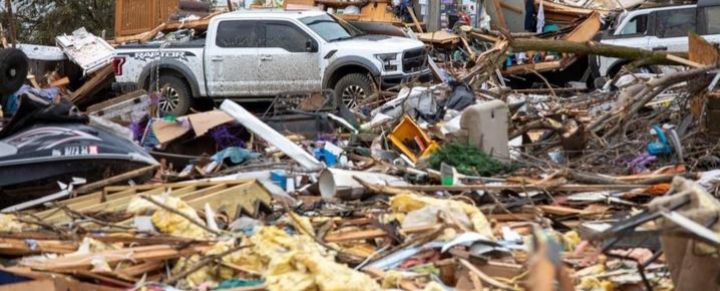
Communities across the American heartland and the Great Lakes region are grappling with deep grief as they begin the difficult process of searching through the remains of neighborhoods devastated by a powerful storm system. Over the past few days, a series of violent weather events tore through parts of Oklahoma and Michigan, leaving at least eight people dead and causing widespread destruction. Emergency crews surveying the damage describe miles of debris, flattened homes, and shattered infrastructure—one of the most severe early-season outbreaks in recent years.
In southern Michigan, the aftermath is especially unsettling. By Saturday morning, the roar of the storm had been replaced by the constant buzz of chainsaws and the rumble of heavy equipment. Rescue workers, volunteers, and residents worked side by side to clear fallen trees and search through rubble that once formed entire neighborhoods. Personal belongings—family photos, furniture, children’s toys—are scattered across muddy fields, stark reminders of lives suddenly disrupted.
For many residents, the disaster felt almost unimaginable. Michigan has traditionally been considered outside the main zone of frequent tornado activity. States in the central Plains—such as Texas and Kansas, which average more than 150 and nearly 100 tornadoes annually—are far more accustomed to preparing for these storms. Michigan typically experiences only a small fraction of that number each year. Because of this, many communities lacked the sense of urgency that accompanies severe weather warnings in regions commonly known as Tornado Alley.
When the skies darkened to an eerie greenish hue on Friday afternoon, few residents expected the level of destruction that would follow. Within minutes, powerful winds tore through neighborhoods that had stood for generations. Witnesses described hearing a deep, rumbling roar—often compared to the sound of an approaching freight train—just before the tornado struck. For those caught in its path, there was little time to react beyond rushing to basements or interior rooms in the hope that the structures above them would hold.
As daylight revealed the damage, the scale of the destruction became clearer. Entire blocks were reduced to splintered wood and twisted metal. Houses were stripped down to bare foundations, and streets were blocked by fallen trees and debris.
Meanwhile, in Oklahoma, where residents are more accustomed to severe storms, the devastation has still left communities shaken. Despite extensive experience with tornado preparedness, even the most resilient towns can be overwhelmed by the strength of powerful storms. When a tornado reaches the highest levels of intensity, the margin between safety and disaster becomes incredibly thin.
Search and rescue operations are ongoing in both states. Emergency crews are using thermal imaging equipment, drones, and specially trained search dogs to locate survivors who may still be trapped beneath collapsed structures. The work is slow and dangerous, complicated by damaged power lines, gas leaks, and unstable debris.
For families waiting for news of missing loved ones, the uncertainty is agonizing. Many neighborhoods are now almost unrecognizable. With familiar landmarks gone and streets blocked by debris, even longtime residents struggle to navigate the altered landscape.
Beyond the immediate damage, communities now face a long list of challenges. Hundreds of families have been displaced, creating urgent needs for temporary housing, food, medical care, and clean water. Schools, community centers, and local gyms have been converted into emergency shelters where neighbors support one another during the early stages of recovery.
The emotional impact is equally profound. Losing a home in a matter of seconds can leave lasting psychological scars. Decades of memories—family milestones, personal keepsakes, and a sense of stability—can vanish in a single storm. Mental health experts say recovery from such trauma often takes years.
Meteorologists are also studying the storm system closely. The unusual strength and northern reach of the tornado activity have raised new questions about how severe weather patterns may be shifting across the United States. Regions historically considered lower-risk may now need to reconsider preparedness strategies, including the construction of stronger shelters and improved warning systems.
Despite the devastation, stories of courage and compassion are beginning to emerge. Residents have been helping neighbors dig through rubble, offering shelter to displaced families, and organizing donations of food and supplies. Volunteers from surrounding communities have traveled long distances to assist with cleanup and support recovery efforts.
The economic impact of the disaster will likely be significant. Local businesses, infrastructure, and homes have been destroyed, and rebuilding entire neighborhoods will take time and resources. Insurance assessments and government assistance programs will play a major role in helping affected communities recover.
In the weeks ahead, national attention may shift elsewhere, but the residents of Michigan and Oklahoma will continue the long process of rebuilding. The lives lost will be remembered, and the lessons from this devastating storm will shape future preparedness efforts.
For now, the focus remains on the most immediate tasks: finding the missing, supporting grieving families, and beginning the difficult work of restoring communities that were forever changed by the storms of March 2026.