The Kidney I Gave Away
Laura Bennett woke to the sharp scent of antiseptic and a deep, aching pull along her left side. It felt as though something vital had been taken from her body. For a few disoriented seconds she didn’t know where she was. Every breath sent a dull burn through her ribs, and her thoughts struggled to focus.
Then the memories returned.
The hospital.
The surgery.
The kidney she had given to save her mother-in-law.
Slowly, she turned her head. Paul had promised her a private recovery room—soft lighting, attentive nurses, maybe even flowers waiting on the table. Instead, the space looked neglected, like an unused ward that had been hurriedly converted into a patient room.
Water stains spread across the ceiling. A cracked clock ticked loudly above the door. Behind a thin curtain someone coughed harshly in the next bed. On a metal tray beside her sat a plastic cup filled with lukewarm water.
When Laura tried to reach the call button, her arm trembled so badly she could barely lift it.
A quiet fear settled in her chest.
It wasn’t just the pain—it was the growing realization that she was completely alone at the moment she needed someone most. She had sacrificed part of herself for this family, yet she had awakened in a place that felt forgotten.
Then the door opened.
For an instant, hope flickered. She expected a nurse checking on her condition.
Instead, Paul Bennett stepped inside.
Something about him felt wrong immediately. He didn’t look emotional or relieved. There were no grateful tears, no gentle concern from a husband whose wife had just undergone surgery.
He looked… composed.
Perfectly dressed in a tailored suit, his hair carefully styled, he resembled someone on his way to a business meeting rather than someone visiting his recovering wife.
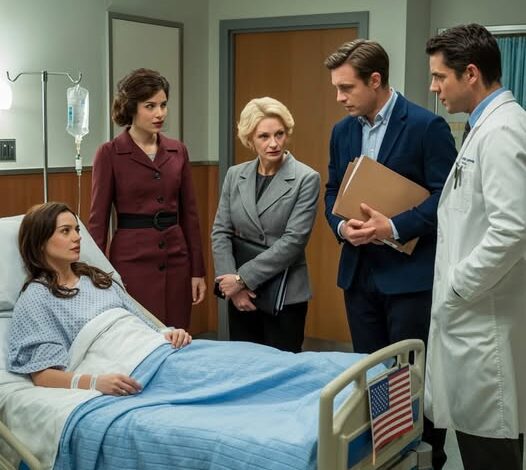
Behind him came Dorothy Bennett in a wheelchair. And beside Paul stood a woman Laura recognized from corporate events—Vanessa Cole. She wore a striking red dress, elegant and confident.
Laura swallowed.
“Paul…” she whispered weakly. “Did it work? Did your mother receive the kidney?”
Paul walked forward without answering. He placed a thick envelope on Laura’s chest. The pressure landed directly over the bandaged incision.
The pain shot through her body.
“That’s your divorce agreement,” Paul said casually. “I’ve already signed it.”
Laura stared at him, certain she had misunderstood.
Divorce?
“But… I just gave you my kidney,” she said faintly. “I saved your mother.”
Dorothy let out a dry, brittle laugh.
“You didn’t save anything,” she said coldly. “You were useful because of what was inside you. Now that it’s gone, so is your usefulness—and your place in this family.”
The room seemed to tilt.
Laura gripped the hospital sheets as everything she believed about the last two years collapsed.
The Performance
Laura had spent her childhood moving between foster homes. By the time she reached adulthood she had learned a painful lesson—love could disappear without warning.
Two years earlier she met Paul at a charity gala.
He seemed different from anyone she had known. He listened when she spoke, remembered details about her past, and made her feel seen.
When he proposed, he said the words she had longed to hear.
“You’ll never be alone again.”
For someone who grew up surrounded by absence, those words felt like oxygen.
But Dorothy Bennett never accepted her.
At dinner she corrected Laura’s posture, her table manners—even how she held a fork.
“No, dear. Like this.”
It always sounded less like guidance and more like criticism.
Whenever Laura mentioned it, Paul dismissed the tension.
“My mother is difficult,” he would say. “Give her time.”
So Laura tried harder.
She cooked the meals. She smiled through comments about her clothes, her hair, even her voice. She believed that if she proved herself worthy, Dorothy would eventually accept her.
This is how people become trapped—not from weakness, but from the simple desire to be loved.
When Dorothy developed kidney failure, Paul came to Laura in tears.
“We need you,” he said.
Laura didn’t hesitate.
She believed the sacrifice would finally make her part of the family.
What she didn’t notice was Vanessa waiting quietly in the background.
She didn’t hear Dorothy calmly say, “Make it happen.”
And she didn’t realize Paul’s affection had always been a strategy.
The paperwork came quickly—too quickly. Consent forms. Risk waivers. Emergency reallocation clauses.
Paul guided her tired hand through the signatures.
“It’s routine,” he assured her.
Laura signed everything.
Because she trusted him.
Because she was exhausted.
Because she believed this sacrifice would finally make her belong.
The Revelation
Vanessa lifted her hand, letting the large diamond ring catch the light.
“Paul and I are engaged,” she said brightly. “And I’m pregnant.”
Laura felt her heart slam painfully against her ribs.
She looked at Paul, hoping—desperately—that this was some kind of mistake.
But his face remained empty.
“We were never really married,” he said calmly. “You solved a problem. My mother needed a kidney, and you were compatible.”
Laura tried to speak.
No words came.
Paul placed a check beside her bed.
“Ten thousand dollars,” he said. “Enough for you to start over somewhere modest.”
Inside Laura something cracked—quietly, slowly.
Then the door opened again.
A tall man in a white coat stepped inside.
His gaze moved from Laura to the heart monitor, and his expression darkened.
“What’s happening here?” he demanded.
Paul straightened.
“This is a private family matter.”
“I’m Dr. Michael Hayes, head of transplant surgery,” the man replied sharply. “And you’re upsetting my patient in my ward.”
Dorothy raised her chin.
“This woman is no longer part of our family. We’re leaving.”
“No,” Dr. Hayes said calmly. “You’re not.”
Paul frowned.
“My mother received the kidney. The operation is over.”
Dr. Hayes turned toward Dorothy.
“The removal surgery was successful,” he said. “But the transplant into you was cancelled.”
Silence fell.
“Cancelled?” Dorothy snapped.
“Your final tests revealed viral markers and organ-rejection indicators,” Dr. Hayes explained. “Continuing would have killed you.”
Paul’s face drained of color.
“Then where is the kidney?”
Dr. Hayes answered calmly.
“Under the emergency reallocation protocol you signed, it was given to the next compatible patient on the transplant list.”
Paul’s voice tightened.
“Who?”
“Richard Hail.”
The Name That Changed Everything
The name echoed through the room.
Even through her pain, Laura recognized it.
Richard Hail was one of the most powerful business leaders in the country—a billionaire known for both innovation and philanthropy.
Paul staggered back.
Dr. Hayes continued.
“The transplant was successful. Your wife saved Mr. Hail’s life. He is recovering in our VIP wing.”
Laura felt something shift inside her.
The kidney she had sacrificed to earn acceptance had saved a stranger instead.
The irony was almost overwhelming.
“You gave it to some—” Paul began angrily.
“No,” Dr. Hayes interrupted. “You signed the documents that allowed it. You were so eager to trap Mrs. Bennett in paperwork that you didn’t bother reading what you signed.”
Dorothy gripped the arms of her wheelchair.
“You’re lying.”
“I do not lie to patients,” Dr. Hayes said calmly.
Then he looked toward the hallway.
“Security.”
Two guards appeared at the doorway.
As Dorothy was wheeled out, she glared back at Laura—not with fear, but with rage at losing control.
The door closed.
The silence that followed felt unreal.
Dr. Hayes turned back to Laura, his voice gentle.
“I’m sorry you had to go through that,” he said. “But one thing is clear—you performed an extraordinary act of generosity.”
He paused.
“And the people you trusted revealed exactly who they truly were.”