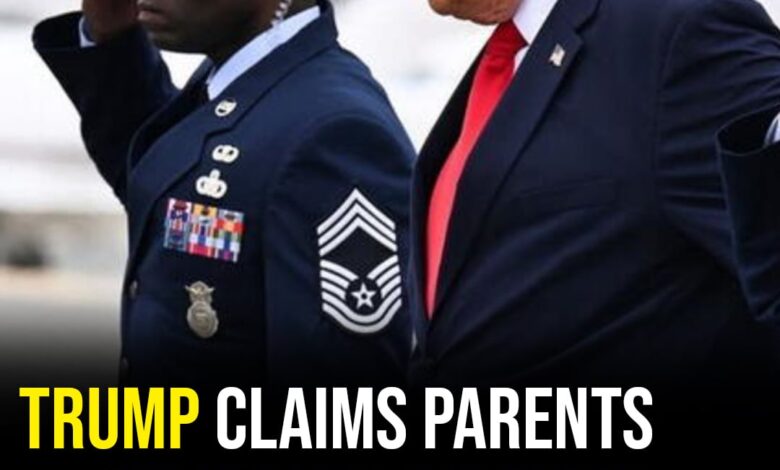
At Dover Air Force Base, where the quiet ceremony of returning fallen service members unfolds with careful precision, the atmosphere is always heavy with grief and reverence. Beneath the solemn rituals—the flag-draped coffins, the steady salutes, the silent lines of military personnel—families confront a loss that no words can truly ease. It is in that setting, Donald Trump says, that he heard a message repeated again and again from the relatives of six American soldiers who had recently been killed.
According to Trump, each family told him the same thing: that their loved ones’ sacrifice must mean something, and that the mission which led to their deaths should be completed. “Finish the job,” he says they told him, a phrase that has since taken on symbolic weight in his retelling of the moment.
The soldiers had been killed when an unmanned aircraft struck a command center in Kuwait, an attack tied to a rapidly escalating conflict in the Middle East. The strike came amid mounting tensions after joint U.S.–Israeli operations reportedly killed Iran’s Supreme Leader, an event that dramatically intensified hostilities across the region. What followed was a chain reaction of retaliatory actions, military alerts, and rising fears that the confrontation could spiral into a wider war.
For the families left behind, grief collided with a desperate search for meaning. The loss of a son, daughter, spouse, or sibling can feel unbearable on its own; when it happens in war, that grief often becomes intertwined with questions about purpose and consequence. Trump has described the conversations at Dover as deeply emotional, saying that the families’ words strengthened his determination to continue the campaign until its objectives were fully achieved.
Those recollections now hover over the ongoing conflict like a moral and political backdrop. Trump has repeatedly characterized the military operation as nearly finished, describing the war effort as “very complete” and even ahead of the schedule some analysts had expected. Yet the situation on the ground tells a more complicated story. Iranian missiles and drones continue to target positions and infrastructure across the region, reminding observers that the fighting is far from fully resolved.
Supporters of the administration’s approach interpret the families’ message as a powerful call for resolve. To them, the phrase “finish the job” reflects a determination not to let sacrifice fade into uncertainty or retreat. They argue that withdrawing prematurely could render the losses meaningless and leave the broader security challenge unresolved.
Critics, however, hear something different in the same story. To them, the words echo a familiar refrain heard in past conflicts—moments when grief and patriotism were invoked to justify continuing wars that ultimately stretched on far longer than expected. They worry that the emotional weight of loss can sometimes be used to sustain military campaigns even when their outcomes remain unclear.
In that sense, Trump’s account of the conversations at Dover has become more than a personal anecdote. It has evolved into a symbol within a larger debate about war, sacrifice, and political leadership. The families’ grief is real and immediate, but the meaning attached to it varies widely depending on one’s perspective on the conflict itself.
Meanwhile, the quiet runways at Dover continue their solemn work. As they have through decades of American wars, they serve as a reminder that behind every strategic decision and every political speech are individual lives—and families—forever changed.
For some, the story of those six soldiers stands as a testament to duty and determination. For others, it is a stark reminder of the human cost that accompanies every promise that a war is close to ending. And as long as missiles still cross the skies and tensions remain high, the question raised by those grieving families lingers: what does it truly mean to “finish the job,” and when can a war really be said to be over?