HOW A HYPOTHETICAL 2028 PRESIDENTIAL SHOWDOWN BETWEEN DONALD TRUMP AND BARACK OBAMA—TWO OF THE MOST INFLUENTIAL, POLARIZING, AND DEFINING FIGURES IN MODERN AMERICAN POLITICS—IGNITED A NATIONAL DEBATE ABOUT TERM LIMITS, DEMOCRACY, CONSTITUTIONAL POWER, AND WHETHER AN AI-GENERATED FORECAST CAN CAPTURE THE REAL ELECTORAL DYNAMICS OF A MATCHUP THAT COULD NEVER LEGALLY HAPPEN BUT CONTINUES TO CAPTURE THE PUBLIC IMAGINATION

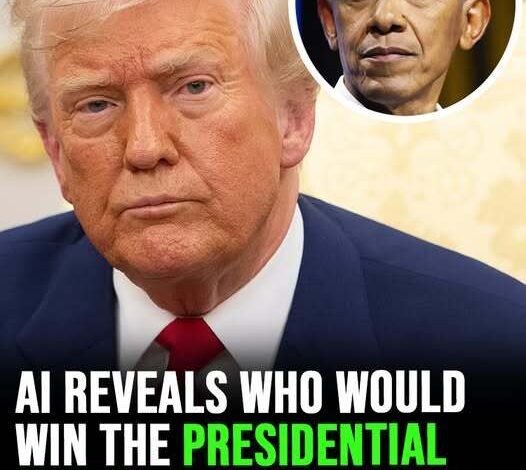
In a political era defined by volatility, personality-driven narratives, and unprecedented levels of public engagement, it often feels as though no scenario is too implausible to entertain. Yet even among America’s endless stream of “what-if” hypotheticals, few capture the public imagination as powerfully as the notion of a 2028 presidential race between Donald J. Trump and Barack H. Obama—two former presidents whose influence over the national psyche has endured long after they left office.
Legally, such a contest is impossible. Constitutionally, it is forbidden. But culturally, rhetorically, and digitally—especially in an age shaped by AI-driven speculation—the idea has taken on a surprising longevity. It persists not because it could happen, but because of what it represents.
An AI-Fueled Revival of an “Impossible” Matchup
The hypothetical resurfaced recently after a popular YouTube channel, I Ask AI, released an artificial-intelligence-generated prediction exploring what might happen if Trump and Obama somehow faced each other in a 2028 election. AI-based political simulations typically invite skepticism. Some dismiss them as entertainment; others see them as reflections of collective anxieties and trends embedded in historical data.
This scenario, however, carried an additional provocation: Trump himself has repeatedly hinted at the possibility of seeking a third term—despite the explicit constitutional prohibition against it.
The video reignited debate around presidential term limits, the resilience of constitutional guardrails, the enduring legacies of both men, and the growing role of artificial intelligence in shaping political imagination. More than a novelty, the hypothetical became a lens through which broader questions about power, authority, and democratic norms could be examined.
The Constitutional Barrier: Why It Cannot Happen
Any discussion of a Trump-Obama rematch begins—and ends—with the U.S. Constitution. The 22nd Amendment, ratified in 1951 following Franklin D. Roosevelt’s four electoral victories, states plainly:
“No person shall be elected to the office of the President more than twice…”
The amendment also restricts individuals who have served substantial portions of another president’s term from repeated election. As a result, both Trump and Obama are unequivocally ineligible to run again.
These limits are widely viewed as essential safeguards against the consolidation of executive power, ensuring leadership rotation and preventing prolonged personal rule—features associated with authoritarian systems rather than liberal democracies.
Yet constitutional clarity has not prevented political speculation.
Trump’s Third-Term Teasing: Rhetoric or Strategy?
Trump has repeatedly floated the idea of a third term, alternately framing it as humor, grievance, provocation, or political challenge. At various events, he has suggested that he “deserves another term” or joked about serving “another four and maybe another four after that.” When pressed directly, he has declined to rule the idea out entirely.
These remarks function less as legal proposals than as political signals. They keep Trump at the center of national conversation, energize supporters, unsettle critics, and test the boundaries of institutional norms.
The speculation escalated when Trump’s former chief strategist, Steve Bannon, told The Economist that he supports Trump pursuing an additional term, claiming—without evidence—that a “plan” exists to circumvent the 22nd Amendment. Constitutional scholars have uniformly rejected such notions as implausible, if not outright impossible.
Still, the rhetoric remains potent. It transforms an abstract legal impossibility into a symbolic question about power, legitimacy, and the durability of democratic norms.
Obama’s Enduring Presence as a Counterweight
Although out of office since 2017, Obama remains a central figure in American political culture. He maintains high favorability ratings, exerts influence through endorsements and public commentary, and occupies a unique symbolic role within the Democratic Party and beyond.
Whenever Trump raises the specter of extended rule, Obama’s name inevitably follows—not as a viable candidate, but as Trump’s most enduring ideological counterpoint. Their presidencies represent sharply divergent visions of governance:
- Obama: multilateralism, institutional norms, technocratic policymaking, and aspirational rhetoric.
- Trump: nationalism, disruption, populist messaging, and confrontational leadership.
In the AI simulation, Obama is framed as a stabilizing force—a candidate whose appeal rests on restoring norms after prolonged turbulence. For many viewers, the hypothetical contest functions as a symbolic clash between political eras rather than a literal electoral scenario.
The AI Verdict: A Confident Obama Win
The AI’s conclusion was unambiguous: in a fictional 2028 matchup, Obama would win decisively.
Its reasoning centered on four themes:
- Voter fatigue following years of polarization and political chaos.
- Diminished incumbency advantage after prolonged dominance by a single political figure.
- Obama’s historically broad coalition, particularly among younger voters, minorities, and moderates.
- Trump’s enduring polarization, which energizes his base but limits expansion.
The AI characterized the outcome not as marginal, but as a “fairly confident” victory—though it acknowledged that no model can fully capture real-world unpredictability.
Why the Hypothetical Endures
The fascination with this impossible matchup persists for deeper reasons:
- Both men remain towering figures in American identity.
- Their political legacies are deeply intertwined.
- The scenario symbolizes a broader ideological struggle.
- AI has become a new medium for political storytelling and speculation.
The debate is less about electoral mechanics than about meaning.
Term Limits, Technology, and Democratic Anxiety
At its core, the renewed interest in this scenario has reopened debate around presidential term limits themselves. Supporters of the 22nd Amendment argue that it preserves democratic rotation, prevents authoritarian drift, and enforces accountability. A small minority counter that voters should retain absolute freedom of choice.
While the amendment is exceedingly unlikely to be repealed or bypassed, the rhetoric surrounding it reflects deeper anxieties about democratic resilience in an era of personalization and technological amplification.
An Impossible Race That Reveals a Great Deal
The significance of this hypothetical lies not in who would win, but in what the scenario reveals about modern American politics:
- A longing for stability amid chaos
- The dominance of personality over policy
- AI’s growing role in shaping political narratives
- The unusually durable legacies of recent presidents
Though neither Trump nor Obama can legally run in 2028, the imagined contest endures as a symbolic canvas—one onto which Americans project their divisions, hopes, fears, and questions about the future of leadership in a rapidly changing political landscape.