‘Chinese Nostradamus’ Sparks Global Debate After Predicting Outcome of Hypothetical U.S.–Iran War, Claiming Conflict Could Reshape the World Order and Warning That Geography, Demographics, and Long-Term Strategy Might Give Iran Unexpected Advantages in a Prolonged Military Confrontation

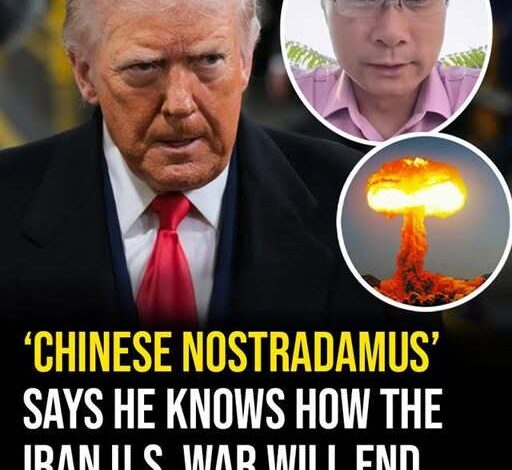
A man often called the “Chinese Nostradamus” online has drawn international attention after making striking predictions about a potential conflict between the United States and Iran. Professor Xueqin Jiang, a Chinese-Canadian educator who studies historical patterns and global developments, has built a large following through his YouTube channel Predictive History.
His forecasts have sparked widespread discussion because some viewers believe earlier predictions he made appeared to align with real-world events. His most recent claim—that the United States would ultimately lose a war with Iran—has intensified debates about global power dynamics and the risks of rising tensions in the Middle East.
Although his predictions remain controversial and speculative, they reflect growing public curiosity about geopolitical forecasting and how historical analysis might help interpret current international conflicts.
Who Is the “Chinese Nostradamus”?
Professor Xueqin Jiang gained the nickname “Chinese Nostradamus” from supporters who believe his predictions about global events have proven unusually accurate.
The comparison refers to Nostradamus, the 16th-century French astrologer famous for cryptic prophecies that people still debate today. Unlike Nostradamus, however, Jiang says his forecasts are not mystical but are instead based on historical research and pattern analysis.
His method, which he describes as “psycho-history,” focuses on examining long-term historical trends and applying those patterns to modern political and military developments.
In his lectures and videos, Jiang often explores topics such as:
- Cycles of rising and declining world powers
- Geopolitical strategy
- Demographic changes
- Cultural and psychological factors that influence conflicts
These discussions have helped his YouTube channel attract viewers looking for alternative interpretations of international politics.
Predictions Made in 2024
In May 2024, Jiang reportedly presented three major predictions during lectures given at a high school in China. Recordings of these talks were later posted on YouTube, where they quickly gained attention.
According to Jiang, his predictions focused on three issues:
- The outcome of the 2024 U.S. presidential election
- The possibility of a military conflict between the United States and Iran
- The result of such a conflict
Supporters argue that the first two predictions have already shown signs of coming true, which has increased interest in the third and most controversial claim.
One of Jiang’s forecasts suggested that Donald Trump would win the 2024 presidential election. He argued that if Trump returned to power, tensions between Washington and Tehran could escalate significantly.
During one lecture he stated:
“If he does become president in a second term, there will be a very strong likelihood that the United States will go to war with Iran.”
This claim attracted attention because it connected political leadership changes in the United States with possible geopolitical consequences.
Rising U.S.–Iran Tensions
Relations between the United States and Iran have been strained for decades. The tension stems from several major events, including:
- The 1979 Iranian Revolution
- Ongoing disputes over economic sanctions
- Negotiations regarding Iran’s nuclear program
- Conflicts involving regional allies and proxy groups
Reports referenced in the discussion suggest that tensions escalated significantly on February 28, raising concerns about potential open hostilities.
Any conflict involving Iran would likely have major consequences not only for the region but also for global security and energy markets.
Jiang’s Most Controversial Claim
The most debated part of Jiang’s analysis is his prediction about the outcome of a hypothetical war between the United States and Iran.
According to him, the United States would ultimately lose such a conflict, an idea that has sparked heated discussions online.
Jiang argues that several structural factors could favor Iran in a prolonged confrontation. These include:
- Geographic advantages
- Population size
- Long-term defensive preparations
In one lecture he said:
“The third big prediction is that the United States will lose this war, which will forever change the global order.”
He believes that a large-scale military campaign against Iran would present significant logistical and strategic difficulties.
Geography and Military Challenges
One of Jiang’s central arguments focuses on Iran’s geography.
Iran is a large country with rugged mountains and complex terrain, which could make military operations difficult for outside forces.
History provides examples where geography played a crucial role in conflicts. Countries such as Vietnam and Afghanistan proved extremely challenging for foreign armies due to terrain and local resistance.
Jiang suggests that Iran’s landscape could similarly complicate any long-term military campaign.
He stated:
“If this war were to happen, there’s absolutely no way America can win this war.”
However, many military analysts emphasize that predicting the outcome of wars is extremely difficult because many factors—such as alliances, technology, and strategy—can influence the result.
The Idea of “Psycho-History”
Jiang attributes his predictions to a method he calls psycho-history.
The term originally comes from science fiction, particularly Isaac Asimov’s Foundation series, where it describes a mathematical system capable of predicting large-scale societal trends.
Jiang uses the concept more broadly to describe analyzing patterns in history, psychology, and geopolitics to anticipate possible future developments.
His analysis often explores the motivations behind political decisions, including:
- National pride
- Historical grievances
- Strategic ambitions
For example, he argues that long-standing mistrust between Iran and the United States has played a major role in shaping current tensions.
Iran’s Long-Term Preparation
Another key part of Jiang’s argument is that Iran has spent decades preparing for the possibility of confrontation with the United States.
He highlights the influence of the Islamic Revolutionary Guard Corps (IRGC) in developing Iran’s military strategy.
According to Jiang, Iranian leaders may consider conflict with the United States inevitable and have therefore focused on building defensive capabilities over many years.
He claimed:
“Iranians have been preparing 20 years for this conflict.”
This perspective suggests that Iran’s long-term planning could provide advantages in a prolonged war of attrition.
Economic Pressure and the Strait of Hormuz
Jiang also discusses the economic implications of a potential conflict.
One of the most strategically important waterways in the Middle East is the Strait of Hormuz, through which a large share of the world’s oil supply is transported.
Disruptions in this narrow shipping lane could have major effects on global energy markets.
Jiang argues that Iran could use control over this region as a powerful strategic tool.
He described it as:
“Waging war against the entire global economy.”
Blocking or restricting the strait could significantly impact international trade and oil prices.
Experts Urge Caution
Despite the attention Jiang’s predictions have received, many analysts remain skeptical.
Predicting geopolitical outcomes is extremely complex because wars depend on numerous variables, including:
- International alliances
- Military technology
- Economic resources
- Diplomatic negotiations
Even well-informed forecasts can prove inaccurate when unexpected events occur.
As a result, experts emphasize that Jiang’s claims should be viewed as speculative interpretations rather than definitive predictions.
Why Such Predictions Gain Attention
The popularity of Jiang’s ideas reflects a broader human tendency to search for explanations about the future.
During times of global uncertainty, people often look for analyses that might help them understand potential outcomes of international tensions.
Predictions—whether from historians, analysts, or commentators—can offer narratives that make complicated geopolitical situations easier to interpret.
However, history repeatedly shows that the future often unfolds in surprising ways.
An Ongoing Debate
Professor Jiang’s predictions have become another voice in the continuing discussion about global power shifts and potential conflicts.
Some viewers consider his analysis a thought-provoking interpretation based on historical patterns.
Others see it as speculation that should be approached with caution.
For now, his prediction that a potential U.S.–Iran war could reshape the global order remains only a forecast.
And, like all predictions about the future, its accuracy can only be judged by how events eventually unfold.