I Refused to Help My Stepson When He Needed Me Most, Two Weeks Later, I Came Home to Something That Changed Me Forever!

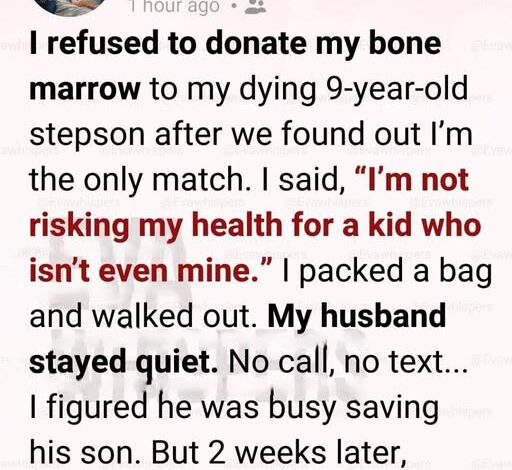
Three years ago, I made a decision that still echoes in my mind. When doctors told us that I was the only compatible bone marrow donor for my nine-year-old stepson, Leo, my first response was no.
Leo wasn’t a distant relative or a child I barely knew. For three years he had been part of my daily life. He ate breakfast at the same table, left his shoes by the door, and curled up beside me during our weekend movie nights. Still, when the doctors explained that my bone marrow was his best chance at survival, I refused.
At the time, my reasoning sounded logical. I talked about medical risks and recovery time. I pointed out that there were no guarantees the transplant would work. I even said something that still haunts me: that Leo wasn’t biologically mine. I told myself I was being practical, protecting my own health and future.
My husband didn’t argue. He didn’t shout or try to convince me. Instead, he met my decision with a quiet silence that felt heavier than anger. That silence unsettled me more than any confrontation could have. Within hours, I packed a bag and went to stay at my sister’s house.
For the next two weeks, I waited for calls. I expected someone from the hospital or my husband to beg me to reconsider. I assumed the pressure would come quickly.
But the phone stayed silent.
At first, I convinced myself that meant everything had worked out. Maybe they had found another donor. Maybe there was another treatment option. I told myself that my refusal no longer mattered.
Eventually, though, the silence started to feel unbearable. After fourteen days, curiosity and unease pushed me to go home. I told myself I just wanted to check on things.
When I stepped inside the house, I immediately felt something was different. The living room walls were covered with drawings—dozens of them, taped carefully side by side. They were simple crayon pictures drawn by a child: stick figures of three people. A tall man, a small boy, and a woman with long hair.
At the top of every drawing was a single word written in careful, uneven letters:
“Mom.”
Leo had never called me that out loud. Not once in the three years I had known him. But in those drawings, he had quietly given me that place in his world.
While I stood there trying to understand what I was seeing, my husband appeared behind me. He looked exhausted, like someone who had been carrying too much weight for too long. Instead of explaining, he led me down the hallway.
At the end was a room we had once used for storage. Now it had been turned into a small medical space. Machines hummed softly. The smell of antiseptic hung in the air.
Leo lay in the bed, smaller and paler than I had ever seen him.
On the table beside him was a plastic container filled with tiny folded paper stars. My husband picked one up and placed it in my hand.
“Leo folds one every time the pain gets too bad,” he said quietly.
Then he told me something I will never forget.
Leo believed that if he folded one thousand stars, I would come back and agree to help him.
I stood there holding the small blue star, realizing that while I had been running from responsibility, a child had been holding onto hope.
Just then Leo stirred. His eyes opened slowly, and when he saw me standing there, he smiled weakly.
“I knew you’d come,” he whispered. “You always come back.”
Hearing those words broke something inside me. I had convinced myself I wasn’t really his mother. But in his mind, I had always been.
I sat beside his bed and held his hand. Then I turned to my husband and asked the only question that mattered.
“Is there still time?”
There was—barely.
I told him to call the hospital and schedule the transplant.
The procedure was difficult, and recovery was slow. There were days when I questioned whether I had the strength to get through it. But Leo’s condition began to improve. Little by little, his color returned, and the doctors started to speak with cautious optimism.
Weeks later, Leo walked into my hospital room wearing oversized socks and holding another drawing.
It was the same picture as before—three people standing together. At the top was the word “Mom,” written bigger and darker than before.
I often think about how close I came to missing that moment. I nearly let fear and logic convince me that love had limits.
What Leo taught me is that family isn’t defined only by biology. Sometimes it’s defined by the moment you choose to stay, even when you’re afraid.
I almost walked away from that choice. But thanks to a child who believed in me more than I believed in myself, I found the courage to come back.