Search Results for: She Sent One Last Text Before Hiking Alone, Nearly a Year Later, an Eagles Nest Revealed the Truth About Her Disappearance!

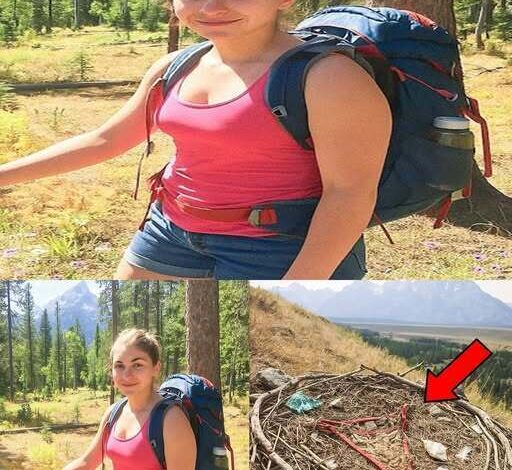
The message arrived just after sunrise, unremarkable in tone, yet it would haunt its recipient forever.
Sarah Turner stood at her kitchen sink, gripping a mug of coffee that had long since cooled, when her phone buzzed on the counter. She smiled when she saw the name.
Amelia.
Off I go. Mountains are calling. Weather’s perfect. Talk Sunday night.
A familiar mix of pride and worry tightened in her chest. Her daughter had always been drawn to open spaces, to silence, to places where the world was pared down to its essentials.
“Be careful,” Sarah typed back. “Love you.”
The message showed as delivered.
It would be the last anyone heard from Amelia Turner.
Amy, as she called herself to friends, was twenty-four, self-assured, and unafraid of solitude. A photographer by trade and temperament, she lived a life shaped around the wilderness. Freelance jobs funded what mattered most: long stretches in the mountains with her camera, her pack, and her thoughts. The mountains weren’t an escape—they were her home.
She wasn’t careless. That detail would become painfully significant.
Amy planned obsessively. Checklists taped inside her gear bin. Maps printed, folded until soft. Backup batteries, backup plans. Friends joked she packed like she was preparing for combat rather than a hike.
On the morning of August 12, she arrived at the String Lake trailhead just after seven. The Tetons rose behind her, their jagged peaks lit by a flawless blue sky. Danger seemed abstract. She parked her silver Subaru, checked her phone one last time, and hoisted her pack.
Before heading out, she asked an older couple to take a photo.
Smiling, sun on her face, hair tied back, she posed in front of the peaks. Alive. Confident.
That photograph would soon appear on missing-person flyers across the country.
Amy was tackling the Paintbrush Canyon–Cascade Canyon Loop, a grueling four-day route with exposed ridges, steep climbs, and rapidly shifting weather. She had plotted every leg, marked campsites, identified water sources, and informed multiple people of her nightly locations.
She had done everything right.
Sunday night came.
No message.
Sarah told herself not to panic at first. Cell service was unreliable. That was normal. But as hours passed, unease hardened into fear.
Amy never missed a check-in.
By Monday evening, Sarah’s hands trembled as she called the sheriff. Rangers arrived at the trailhead that night.
Amy’s car remained parked.
By morning, she was officially missing.
Search teams mobilized immediately. Helicopters swept the canyons, dogs scoured trails, and rangers examined every segment of her planned route.
They found her campsite at Holly Lake.
The tent was intact, sleeping pad laid neatly, a small daypack inside.
But her main pack and boots were gone.
It made no sense. No experienced hiker would abandon essential gear without reason.
Dogs traced her scent, leading off the trail, up a steep slope, across unstable rock, and then stopping abruptly—as if she had vanished.
Witnesses recalled a man on the trail that morning: thin, unremarkable, carrying a military-style pack. Forgettable… until now.
A sketch was made. No name surfaced.
After ten days, storms erased tracks and scent. The official search was suspended.
For Mark Turner, her father, that was intolerable.
Mark, a surveyor, believed every detail of the land could reveal truth. When helicopters stopped flying, he began his own methodical search.
Weekend after weekend, he returned to the Tetons. He studied satellite images, geological surveys, and erosion patterns. He searched slowly, deliberately, noticing what broad searches overlooked—subtle depressions, displaced vegetation, places where the land felt… wrong.
He wasn’t chasing miracles anymore.
He was chasing his daughter.
Online, Amy’s disappearance sparked theories. Hiking forums retraced her route. Some blamed accidents, others wildlife. And some whispered about the man on the trail.
Months passed. Winter buried the mountains in snow. Headlines moved on.
Nearly a year later, a fisherman spotted one of Amy’s trekking poles lodged in Cascade Creek. Proof she had been there, but nothing about what had happened. Mark returned to the mountains, relentless.
Then, one July, something unexpected.
A park ranger monitoring golden eagle nests climbed a remote cliff. Eagles use whatever materials they find—branches, fur, scraps. But woven into this nest was fabric that did not belong.
Turquoise nylon.
Clothing.
Investigators knew immediately what it meant. Eagles didn’t hunt humans. They scavenged.
The search area contracted from hundreds of square miles to one mountainside.
A recovery team moved in. Dogs swept the terrain. On the third day, one dog froze, sat—the trained signal of discovery.
Amelia Turner was found.
The autopsy revealed the rest. No fall. No animal attack. She had been assaulted. Murdered.
The sketch was released again, now labeled properly: suspect.
Within days, a motel clerk recognized him. A drifter, paying in cash, disappearing suddenly. Names and trails emerged.
He was arrested at a Montana ranch. In his possession were trophies—IDs, jewelry, and Amy’s camera.
The memory card confirmed everything.
He confessed without emotion. “She shouldn’t have been alone,” he said.
The trial was swift, the evidence overwhelming. He received life without parole. Other families, long awaiting closure, finally found answers.
Amy’s memorial took place on a Teton overlook. The wind moved through the grass. The mountains remained unchanged.
Mark spoke once:
“I just wanted to find my daughter.”
Amelia Turner was found. She came home. She was not forgotten.
Her story now stands as a warning etched into the wilderness itself: not every threat in the mountains comes from nature. Sometimes, the predator walks the trail beside you.