I Bought A Shawarma And A Coffee For A Homeless Man And The Note He Gave Me Reached Back Through Time

That night, the cold felt sharper than usual—cutting through my coat, through my routine, even through the quiet sense of control I thought I had over my life. I had just finished a late shift at the sporting goods store where I’d worked for nearly two decades. My mind was still cluttered with small frustrations—customers, bills, my daughter struggling with school, the constant balancing act of everyday life.
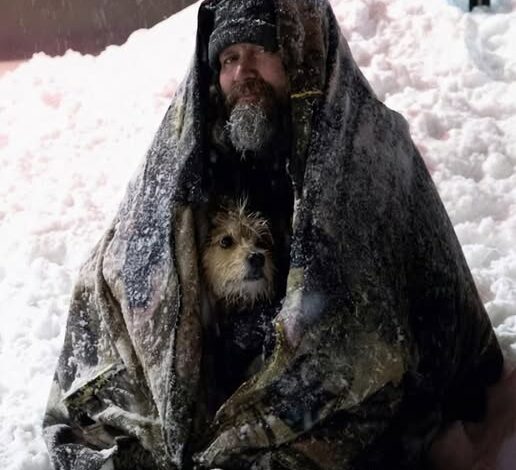
The wind dragged bits of paper across the pavement as I headed toward the bus stop. That’s when I noticed the soft glow of a shawarma stand. Nearby, a man stood with his shoulders hunched against the cold, a thin dog pressed close to his side. Both of them stared at the food with a kind of quiet hunger that didn’t need words.
When the man asked the vendor for some hot water, the response came back harsh and dismissive, loud enough to turn heads. Something about that moment stayed with me. It reminded me of something my grandmother used to say—that even the smallest kindness can carry more weight than we realize.
Before I could second-guess it, I ordered two shawarmas and two coffees. I walked over and handed them to him. His hands shook slightly as he took them, and the way he thanked me—soft, sincere—made me feel oddly uncomfortable, like I had stepped into something bigger than I intended. I gave a small nod, ready to leave, but he stopped me.
“Wait,” he said quietly.
He pulled out a pen and a small piece of paper, scribbled something quickly, and handed it to me. “Read it later,” he added.
I slipped it into my pocket and went home. Life picked up where it always did—homework spread across the table, small disagreements between the kids, my husband talking about his day. The note faded into the background.
Until the next evening.
As I emptied my coat pockets before doing laundry, I found the folded paper. I opened it without thinking—but the words made me pause.
“Thank you for saving my life.
You already saved it once before.”
Beneath that was a date from three years earlier—and the name of a place I hadn’t thought about in a long time.
Lucy’s Café.
The memory came rushing back. A stormy afternoon. A crowded room filled with people escaping the rain. A man walking in, soaked, exhausted, carrying something heavier than just wet clothes. I remembered how people avoided looking at him.
And I remembered buying him a coffee and a croissant.
At the time, it had felt like nothing. Just a small gesture. Something ordinary. Something I didn’t expect to matter.
That night, I barely slept. The idea that such a simple moment could have meant so much stayed with me.
The next day, I went back to the shawarma stand. He was there again, the dog curled up beside him. This time, I didn’t just pass by.
His name was Victor.
We sat in a nearby café, the warmth making it easier to talk. He told me about his life—how he used to work as a truck driver, how an accident on a rainy night had changed everything. Injuries, debt, and the lack of support had slowly unraveled the life he once knew. His family drifted away. Depression took hold.
He told me that the day at Lucy’s Café had been his lowest point. He hadn’t planned on continuing. But that small moment—being noticed, being treated with kindness—had made him stay, just for one more day. Then another.
Later, finding the dog gave him something else to hold onto. A reason to keep going when everything else felt gone.
Listening to him, I realized how fragile stability really is. How quickly things can fall apart. And how often people are held together by moments that seem insignificant to everyone else.
With my husband’s help—he understood the legal system better than I ever could—we started helping Victor piece things back together. Paperwork, identification, applications for support. My kids got involved too, bringing their friends along. What started as a single act grew into something shared.
Within a month, Victor had a place to stay. A job. A sense of direction again.
A year later, on my birthday, he stood at my door. He looked different—stronger, steady. In his hands, he carried a cake. He didn’t say much, but he didn’t need to.
And I couldn’t stop thinking about how easily I could have walked past him that night—caught up in my own thoughts, my own problems—never knowing what that moment might have meant.
Sometimes, it’s the smallest choices that leave the deepest marks.
The kind you don’t see right away.
The kind that change everything.