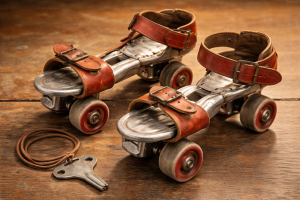
“If You Were a Child or Teenager Between the 1950s and 1970s, You May Remember This Strange Object That Captured Curiosity, Defined Generations, Sparked Endless Conversations, and Still Holds a Place in Nostalgia as a Symbol of Simpler Times and Forgotten Everyday Wonders From the Past”


A Curious Object from Another Time
For children growing up in the 1950s through the 1970s, the world was full of strange, fascinating objects that didn’t always make sense at first glance. Some toys looked like tools, some tools felt like puzzles, and many everyday items required a bit of explanation before their purpose became clear. Among the most memorable of these was a peculiar device made of metal, straps, and a tiny key—something that looked more suited for a toolbox than a toy box.
But for those who remember, the mystery quickly fades into recognition. These were the roller skates of a generation.
Before Modern Skates Took Over
Long before lightweight, padded roller skates became the norm, children used versions that were far more rugged. These early skates were made almost entirely of metal and were designed to attach directly to whatever shoes you were already wearing. Leather or canvas straps wrapped tightly over your feet, turning everyday footwear into something that could glide—at least in theory.
They weren’t smooth or particularly comfortable, and safety wasn’t exactly a priority. But none of that mattered. For kids of that era, strapping these onto their shoes meant freedom. It meant motion, independence, and the thrill of turning an ordinary sidewalk into something much more exciting.
The Importance of the Skate Key
What made these skates truly unique was the small but essential tool that came with them: the skate key.
This little metal key was used to adjust the size of the skates, allowing them to expand or contract to fit different shoes. Without it, the skates couldn’t be tightened properly—and were practically unusable. Many kids wore the key on a string around their neck, knowing how important it was.
Of course, it often got lost. And when it did, it became a neighborhood problem. Kids would borrow keys from friends, improvise fixes, or plead with their parents for a replacement. Owning the key wasn’t just practical—it was part of the experience.
Sidewalk Adventures and Street Races
Once the skates were secured, the real fun began. Sidewalks turned into racetracks. Driveways became practice zones. Entire neighborhoods echoed with the clatter of metal wheels rolling over concrete.
These skates weren’t quiet. They rattled, scraped, and clanked with every push forward. Balance was tricky, stopping wasn’t easy, and falls were common. Scraped knees and elbows were part of the deal—but they were worn like badges of honor.
What mattered most was being outside, moving, and sharing the experience with friends. It wasn’t polished or perfect, but it was real.
A Nostalgia That Still Lives On
Today, finding a pair of these vintage skates—especially with the original key—instantly sparks memories. People who see them often pause, smile, and say, “I remember those.” And just like that, stories come pouring out—about races down the block, near-misses with curbs, and the unmistakable sound of metal wheels on pavement.
That sound, for many, is as nostalgic as the ring of an ice cream truck or the chalky smell of a schoolyard. It represents a time when play was simple, physical, and shared face-to-face.
More Than Just an Old Toy
Collectors today may value these skates as pieces of mid-20th-century history, but their true worth goes beyond money. They are reminders of a different kind of childhood—one without screens, where imagination and movement filled the day.
If you happen to still have a pair tucked away, especially with the key, you’re holding more than a vintage item. You’re holding a piece of a world where fun was found outdoors, where small inventions brought big joy, and where even something as clunky as a metal skate could feel like freedom.