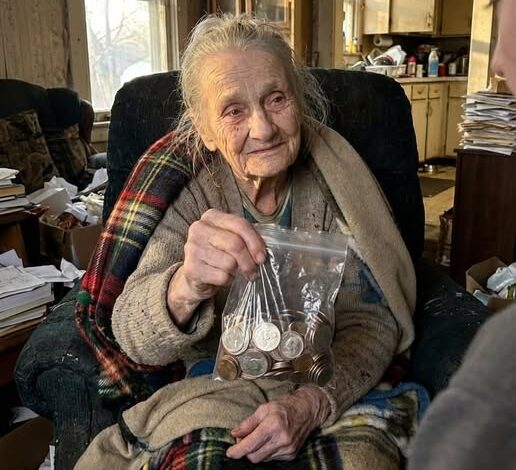
The accusation cut deeper than the cold ever could—that kind of cold that doesn’t just touch your skin, but settles somewhere inside you and refuses to leave. It wasn’t the weather that lingered with me afterward. It was her voice. Fragile, shaking, yet somehow sharp enough to slice through everything else. Four words, simple and heavy: “This is your fault.” They didn’t pass through me. They stayed—echoing, repeating, reshaping everything I thought I understood in that moment.
Up until then, my actions had felt straightforward. Human, even. But suddenly, they didn’t feel that way anymore. What had seemed like kindness now carried the possibility of harm. Doubt crept in quietly at first, then grew louder, joined by a sense of guilt I hadn’t expected. I kept circling the same question without finding an answer: had I helped—or had I crossed a boundary I didn’t fully see?
Nothing around me paused to give space for that question. The world kept moving. Neighbors spoke in low voices that somehow felt amplified. The distant sound of sirens stretched the moment into something unreal, like I was standing inside a scene I didn’t fully understand. What had started as a routine delivery had shifted into something heavier, something complicated enough to follow me long after I left.
I couldn’t shake the memory of her home. The cold inside it had felt different from the cold outside—denser, more permanent, like it had settled into the walls over time. Even the faint candlelight seemed uncertain, flickering as if it might give out at any second. She stood there counting coins, her hands trembling slightly. It wasn’t just the cold causing it. There was effort in every movement, in every coin she placed into that small bag. It felt like she was giving more than money—like she was parting with something she couldn’t easily replace.
Walking away without taking it had felt instinctively right. I didn’t question that part. But leaving everything else as it was didn’t sit right either. Calling for help hadn’t felt like interference at the time—it had felt necessary. Like ignoring what I had seen would be a kind of failure. I told myself it came from concern, not judgment.
But standing there later, under the weight of her words and the silent attention of those around us, that certainty began to unravel. What had felt clear now felt layered, tangled in ways I hadn’t anticipated. I went back through every moment, searching for where things might have shifted. Had I misread the situation? Acted too quickly? Or worse—had I taken away something from her without realizing it? Her independence, her dignity, her ability to choose?
The days that followed didn’t bring answers. Instead, they stretched the questions out, giving them more room to settle in. The memory surfaced at unexpected times—in quiet moments, in passing thoughts, in the uneasy awareness that doing what seems right doesn’t always feel right afterward. I started questioning more than just that night. I questioned my instincts. What does it actually mean to help someone? When does care become intrusion? And who decides where that line is?
A week later, I found myself back in front of her house. I hadn’t planned it, not exactly, but there I was—standing still for a moment before walking up. I wasn’t sure what I expected. Maybe anger. Maybe distance. Something that would confirm the weight I’d been carrying all week.
But what I walked into was different.
The house no longer felt hollow. There was warmth—not just from heat, but from presence. Light filled the space where there had once only been shadows. The kitchen held signs of life: food on the counters, voices moving through the rooms, neighbors coming and going as if they belonged there. The stillness I remembered had been replaced by something shared, something alive.
When she looked at me, I braced myself without realizing it. I searched her face for the same sharpness I’d heard in her voice that night. But it wasn’t there.
Instead, there was something quieter. Softer.
Gratitude.
It wasn’t dramatic. She didn’t dwell on it or try to explain everything that had changed. She simply said “thank you.” And somehow, that was enough to shift something inside me. It didn’t erase the doubt I had felt or the discomfort I had carried. But it reframed it.
I began to understand that the moment I had held onto—the accusation, the tension—wasn’t the full story. It was just the first reaction, raw and immediate. The part that surfaces when people feel exposed, when help arrives before they’re ready to accept it. With time, that reaction had made space for something else.
Perspective.
What had felt like interference in that moment had, over time, become support. What had seemed like a mistake had opened the door to something bigger than I could have done on my own.
That’s when it became clear to me: doing the right thing doesn’t always come with immediate reassurance. Sometimes it feels uncertain. Sometimes it feels uncomfortable. And sometimes, it means being misunderstood—at least for a while.
Caring isn’t always gentle or easy. It can disrupt, challenge, and even upset the very people it’s meant to help. And yet, that doesn’t make it wrong.
What matters is the willingness to step in when something doesn’t feel right—and just as importantly, the willingness to reflect afterward. To question yourself. To sit with the discomfort instead of pushing it away.
Because in the end, helping someone isn’t about being unquestionably right. It’s about being present enough to act, even when the outcome isn’t clear—and patient enough to understand that clarity doesn’t always come immediately.
Sometimes, it comes later, when everything has settled. When the noise fades. When the moment can finally be seen for what it truly was—not perfect, not simple, but meaningful in a way that only time can reveal.