My Daughter Made Her Prom Dress Out of Her Late Father’s Uniform – When Her Mean Classmate Poured Punch on It, the Girl’s Mother Grabbed the Mic and Said Something That Froze the Whole Gym

“I don’t even want to go,” Wren said quietly.
We were in the hallway after check-in, standing near the glittery prom poster—A Night Under the Stars—all gold lettering and forced magic. She barely glanced at it before shrugging.
“It’s all pretend anyway.”
She walked ahead, like it didn’t matter. Like none of it ever had.
But later that night, I found her in the garage.
She stood frozen in front of the storage closet, the door hanging open. Inside, a garment bag swayed slightly, like it had just been touched.
Her father’s uniform.
Her hands hovered near the zipper, not quite brave enough to open it. Then, almost too soft to hear:
“What if he could still take me?”
I said her name, and she startled, turning too quickly.
“I wasn’t—”
“It’s okay,” I told her.
She looked back at the bag. “I know it sounds stupid, but… if I did go… I’d want him there. And I thought maybe… I could use this. Turn it into something.”
Wren had spent years pretending she didn’t want things other girls did. Dances. Trips. Moments that required a father standing beside her.
She’d learned to bury disappointment so deeply it became part of who she was.
So I stepped closer and said, “Then let’s see it.”
She hesitated, then slowly unzipped the bag.
The uniform was still perfect. Pressed. Untouched by time in a way that felt unfair.
She brushed the sleeve with her fingertips. “I think I could make it into a dress.”
I wrapped an arm around her shoulders. “I think you should.”
The house changed after that.
Fabric spread across every surface. The dining table disappeared under patterns and scraps. Needles turned up in places they absolutely shouldn’t. Late nights became normal.
She worked like it mattered—because it did.
The badge stayed on the mantle most of the time.
Not his official one. That had been returned after the funeral. This one was different.
I remembered the night he gave it to her.
She’d been three, sitting cross-legged on the floor when he came home and crouched beside her.
“I made you something,” he said.
It wasn’t real, but it looked real enough. Polished metal, his number written carefully across it.
“So you can be my partner.”
She held it like it was the most important thing in the world. “Am I a police officer too?”
He smiled. “You’re my brave girl.”
Weeks later, when the dress was nearly finished, Wren picked up that badge again.
“I want it here,” she said, pressing it over her heart.
I hesitated.
People misunderstand things. They judge fast, without asking why.
But she already knew that.
And she wanted to wear it anyway.
So I nodded. “Then that’s exactly where it belongs.”
When she came downstairs on prom night, I forgot how to breathe.
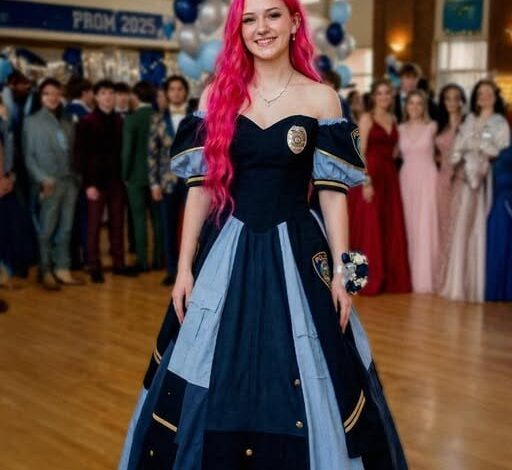
The uniform was still there—but transformed. Softer lines. Elegant shape. Something strong and gentle at the same time.
And over her heart—the badge.
We walked into the gym together, and heads turned instantly.
Not in a cruel way. Not yet.
Just… attention.
One woman near the drinks table noticed right away. She looked at the badge, then at Wren, and gave a small, respectful nod.
Wren felt it. I saw it in the way she straightened.
And then everything shifted.
A girl approached—confident, polished, surrounded by friends who echoed her energy.
She looked Wren up and down and laughed.
“Oh wow,” she said loudly. “This is… kind of tragic.”
The room quieted in that awful way it does when people sense something about to happen.
Wren froze.
“You really made your whole look about a dead cop?” the girl continued, smirking. “That’s… a lot.”
Wren tried to move past her, but the girl stepped in front again.
“You know what’s worse?” she added, voice sharper now. “If he is watching… he’s probably embarrassed.”
I started forward—but too late.
The girl lifted her cup and dumped it straight onto Wren’s chest.
Red punch spread instantly, soaking the fabric, bleeding into every careful stitch, dripping over the badge.
For a second, nobody moved.
Then the phones came out.
Wren didn’t cry. She just looked down and started wiping at the badge, fast and frantic, like she could undo it if she tried hard enough.
And then—
Feedback screamed through the speakers.
Everyone turned.
A woman stood at the DJ table, gripping the microphone so tightly her hand shook.
“Do you even know who that officer is to you?” she said.
The girl blinked. “Mom, what are you doing?”
Her mother’s voice cracked—but didn’t break.
“He saved your life.”
Silence.
“There was an accident,” she continued. “You were trapped in the back seat. I couldn’t reach you. The car was filling with smoke.”
The entire room leaned in.
“He didn’t hesitate. He broke the window and pulled you out himself. You were screaming. He just kept telling you, ‘You’re safe now.’”
Then she pointed.
At Wren.
“At that badge. I recognized the number the second I saw it.”
The girl shook her head. “No.”
“Yes,” her mother said. “The man you just mocked is the reason you’re standing here.”
Everything changed in that moment.
Phones lowered.
Whispers spread.
Wren’s hands stilled over the badge, still stained but steady now.
“I’m sorry,” the girl said, her voice small for the first time.
Wren took a breath.
“You shouldn’t need someone to save your life to treat them with respect,” she said.
The words landed hard.
“My dad mattered before you knew what he did for you.”
No one spoke.
Then her mother stepped forward. “We’re leaving.”
The girl didn’t argue.
She just followed, smaller somehow, as the crowd parted around her.
For a few seconds, nothing happened.
Then someone started clapping.
Another joined.
And another.
Until the whole room filled with it.
Wren turned to me, overwhelmed, unsure.
“Stay,” I whispered.
A girl came over with napkins. “It still looks beautiful,” she said gently.
Wren let out a shaky laugh.
We cleaned what we could. The stain didn’t disappear—but the badge shined again when she pressed it flat against her chest.
The music started back up.
“You don’t have to dance,” I told her.
She shook her head. “Yeah… I do.”
And then she walked forward.
Not perfectly. Not untouched. But steady.
And when the crowd made space for her, it wasn’t out of pity.
It was respect.
That’s what stayed with me.
Not the cruelty. Not the shock. Not even the truth that changed everything.
It was that walk.
Her dress marked, her eyes still bright with tears—but walking anyway.
For the first time, she wasn’t defined by loss.
She was just Wren.
A girl carrying her father with her in the only way she knew how.
A girl who turned grief into something real.
And in that moment, I could almost hear him again—
“That’s my brave girl.”