Donald Trump makes wildly inappropriate Pearl Harbor joke in front of Japanese PM – leaving everyone stunned

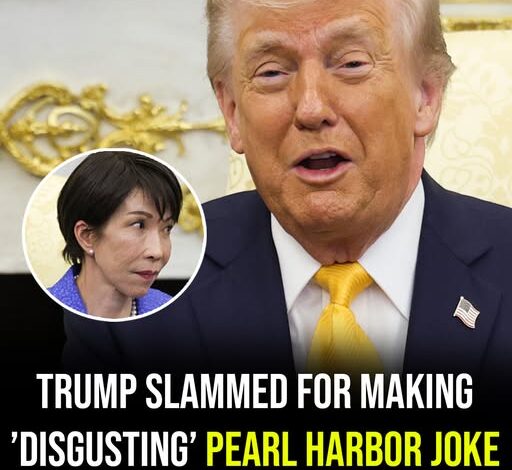
The Oval Office is meant to be a space where every word carries weight, where language is chosen carefully because of what it represents—not just in the moment, but in history. Yet in this case, that expectation seemed to fall away. In front of Japan’s Prime Minister, a remark intended to land as humor instead struck something far deeper and far more sensitive.
According to those present, the reaction wasn’t immediate outrage, but something quieter—and in many ways, more telling. A pause. A stillness that settled over the room, as if everyone understood at once that a line had been crossed. It wasn’t simply a matter of tone or timing. It was the sense that something tied to shared history—something heavy with loss and consequence—had been handled too lightly.
References to Pearl Harbor attack are never neutral. For the United States, it represents a day of sudden devastation, lives lost, and a turning point that drew the nation into global war. For Japan, it is part of a complex and painful history that ultimately led to immense suffering on all sides. What followed that moment was not just conflict, but years of destruction that reshaped the world.
And yet, out of that past came something else: a hard-earned alliance. The modern relationship between United States and Japan is built not on forgetting history, but on acknowledging it—on understanding the cost of war and choosing cooperation instead. That’s what gives such moments their weight. When history is referenced casually, it risks feeling less like reflection and more like reduction.
What made the situation so striking was not just the remark itself, but the contrast between setting and substance. In a room defined by diplomacy and symbolism, even a brief lapse can carry outsized meaning. Words spoken there don’t stay contained—they echo outward, interpreted not only by those present but by audiences far beyond.
Critics of the moment argue that it illustrates how easily power can blur the line between familiarity and carelessness. When leaders speak, their words are rarely just personal—they are seen as extensions of national voice and memory. A misstep, even a small one, can feel like it diminishes something that others hold as deeply significant.
At the same time, such moments often prompt reflection rather than resolution. They raise questions about how history should be remembered, how it should be spoken about, and who carries the responsibility for preserving its meaning. Humor, in many contexts, can bridge divides—but when it touches on events marked by loss and trauma, it can just as easily reopen them.
Long after the meeting ended, what lingered was not just the comment, but the silence that followed it. A silence shaped by shared awareness—of history, of sacrifice, and of how fragile respect can feel when those elements are set aside, even briefly.
In the end, the moment leaves behind a question that extends beyond any single remark: what happens when memory is treated as something to use, rather than something to honor?