High in the still, unforgiving air of the Alps, where sound is swallowed by wind and distance, the landscape offers little more than rock, ice, and sky. It was in this stark, isolated setting—on a narrow, windswept ridge above the treeline—that a group of hikers made a discovery that would bridge decades of silence. What first appeared as a dark, jagged shape breaking through the snow soon revealed itself to be something far more haunting: the fractured remains of a long-lost aircraft.
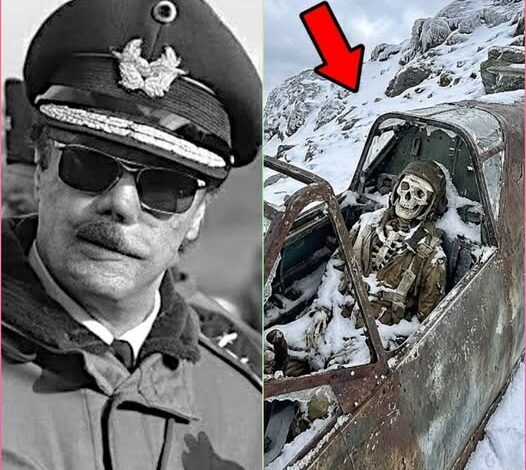
As they carefully brushed away layers of powder, the metallic surface emerged—twisted aluminum panels, corroded bolts, and the unmistakable markings of a Messerschmitt Bf 109, its faded insignia still visible despite the passage of more than eighty years. Inside the cockpit, preserved by ice and time, lay the skeletal remains of a pilot, still strapped into his seat. His posture, slumped forward, suggested a final moment of concentration—frozen forever in the instant before impact.
The mountain had finally given up its secret: the fate of Leutnant Franz Müller.
In March 1943, at just twenty-three years old, Müller had departed from a military base in northern Italy on a solo reconnaissance mission near the Swiss border. Unlike many of his peers, he was not driven purely by duty or ideology. He had once been an engineering student, fascinated by mechanics and flight, viewing the sky as a realm of possibility rather than conflict. Letters later recovered would paint a picture of a thoughtful and conflicted young man—someone who questioned the war even as he participated in it. In one letter to his sister, he described the sky as something that could “swallow men whole,” and expressed an uneasy feeling that the mountains themselves might one day claim him.
On March 14, that fear became reality.
A sudden Alpine storm swept through the region, bringing with it a complete whiteout—blinding snow, violent winds, and near-zero visibility. In such conditions, even the most skilled pilots could lose all sense of direction. Müller’s aircraft disappeared from radar, swallowed by the storm and the vastness of the mountains. Search efforts at the time were brief and ultimately unsuccessful, hindered by dangerous weather and the mounting pressures of a war already turning against Germany. His name was recorded among the missing, and over time, like so many others, his story faded into obscurity.
But the mountain had not forgotten.
Encased in ice, the wreckage became part of a slow-moving glacier. The freezing temperatures and lack of oxygen created a natural preservation chamber, protecting both the aircraft and its pilot from decay. Rather than shattering on impact, the plane had slid into a snowfield, where it was gradually buried under layers of ice. For decades, it moved almost imperceptibly—just centimeters each year—as the glacier shifted downhill.
It was only in recent years, as rising global temperatures accelerated glacial melting, that the frozen past began to reemerge. Piece by piece, the aircraft was exposed to the surface once more, until it was finally discovered.
When recovery teams arrived—transported by helicopter into the remote terrain—the operation was carried out with quiet reverence. Specialists worked carefully to extract the remains and preserve the site. Alongside the pilot, they recovered personal and military artifacts: a rusted sidearm, fragments of flight maps damaged by moisture, and a logbook whose pages had fused together over time. Around his neck, still intact after decades, hung his identification tags—bearing the name Franz Müller.
What had once been a cold entry in a wartime record was now undeniably human again.
Through DNA analysis and historical research, his identity was formally confirmed. The discovery transformed a forgotten disappearance into a completed story. For surviving relatives—if any remained—it offered something that had long been absent: closure. No longer missing, no longer unknown, Müller’s fate had been brought into the light.
His remains were prepared for burial with dignity, and the artifacts cataloged as part of a story that spanned generations. The young man who had vanished into a storm in 1943 was no longer lost to history. Instead, he became a reminder of the countless lives suspended in time by war—lives with dreams, doubts, and unfinished journeys.
For more than eighty years, the Alps had guarded this secret in silence. And when the moment came, they returned not just wreckage, but a story—one that restores a name, a face, and a fragment of humanity to a past too often told only in numbers.