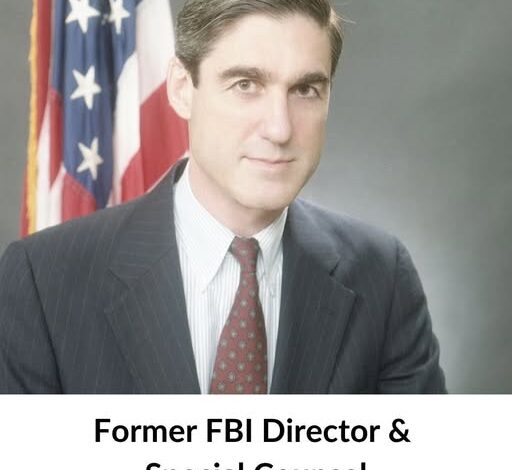
Robert Mueller’s life traced the hard, disciplined backbone of American institutions: Marine officer in Vietnam, Bronze Star recipient, career prosecutor, and ultimately, the man entrusted with leading the FBI just days before 9/11. In each role, he embodied a kind of stoic authority rarely seen in public life—a presence that was quiet but commanding, precise but unassuming, the figure in the background when crises erupted and the nation watched in fear. His career was a study in discipline, resilience, and discretion. Decisions that shaped national security, criminal justice, and political accountability were often his alone to bear, executed without fanfare, without the applause or condemnation that follow more public figures. For years, both political parties claimed him when convenient, celebrated his integrity when it suited their purposes, and cursed him when he refused to bend to partisan pressure.
Mueller’s reputation was built on consistency. He followed rules, upheld standards, and maintained a personal code that seemed almost unshakable. He was the embodiment of the civil servant ideal: competent, loyal, and, above all, discreet. Even in moments when the nation seemed to teeter on the edge—after terrorist attacks, during high-profile prosecutions, or amid political upheaval—Mueller remained measured, deliberate, and unflinching. The public rarely saw him, and perhaps that was intentional; he operated best as a steady hand in unseen corridors, letting institutions, rather than personalities, carry the weight of governance.
His final and most scrutinized role—the investigation into Russian interference in the 2016 election—placed him in a historically unprecedented spotlight. Suddenly, the quiet figure of authority became the center of a national debate, interpreted through the lens of deep political divisions. Some viewed him as a cautious patriot, constrained by law, norms, and procedure, navigating treacherous waters with meticulous care. Others saw him as hesitant, even reluctant, flinching when confronted with the edge of accountability. Every decision, every public statement, every omission was analyzed, dissected, and debated. The investigation illuminated the extraordinary tension between institutional fidelity and the expectations of a polarized public. In doing so, it cemented Mueller’s place as a symbol: a figure who could inspire trust in some while provoking frustration in others, simply by adhering to the principle that process matters, even when politics does not.
With his passing, the full scope of his judgment will never be fully known. There will be no additional clarifications, no supplemental report, no candid, late-in-life interview to reveal his inner deliberations. The doubts, the private calculations, the moral and legal reasoning that guided him through decades of service are now beyond reach. What remains are the enduring institutions he helped shape—the FBI, the Justice Department, the broader apparatus of law enforcement and national security. They carry forward, resilient, precise, and professional, but the intimate understanding of why certain decisions were made, the nuance behind choices that affected millions of lives, resides solely with him now.
Robert Mueller’s legacy is therefore paradoxical: it is monumental, yet incomplete; admired, yet enigmatic. He leaves behind institutions strengthened by decades of disciplined service, yet the human insight behind those institutions—the reasoning, hesitation, and courage that guided him—is irretrievably lost. He was a man who lived within the structures of the nation, protecting them, shaping them, and ultimately embodying them. In the end, the nation retains the framework, the rules, and the enforcement of law, but the man who quietly bore the weight of America’s trust, who navigated fear, political pressure, and historic crises with unshakable composure, is gone—and with him, the answers that only he could have provided.