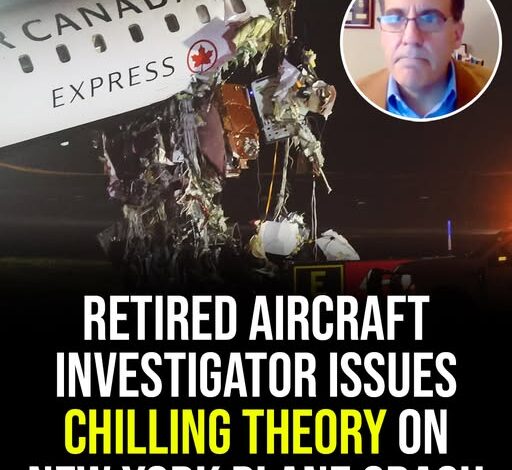
In the quiet darkness just before midnight, Flight 8646 should have been an ordinary, uneventful arrival. Its 76 passengers, exhausted from long flights or thinking ahead to early meetings and the comfort of their own beds, had no reason to suspect that the last moments of their journey would become a scene of unimaginable horror. Instead, the Boeing jet collided with a fire truck on Runway 4. At a speed barely above highway pace—just 24 miles per hour—the impact was deceptively slow, yet violent enough to instantly claim the lives of both pilots in the cockpit. The frantic cries from air traffic control—“Stop, Truck 1, stop!”—echoed through the radio seconds too late. Those words, now replayed in transcripts and investigative footage, no longer serve as a warning but as haunting evidence of a breakdown in the very system designed to prevent such tragedies.
Passengers describe moments of terror frozen in disbelief: a sudden jolt that threw them forward, alarms and lights flashing, confusion in the cabin, and the immediate realization that something had gone terribly wrong. Emergency crews arrived in minutes, racing across the tarmac with sirens blaring and hoses ready, yet the cockpit held the ultimate tragedy. Families of the deceased pilots are left grappling with inconceivable loss, their grief compounded by the fact that this death came not from accident or illness, but from a sequence of preventable errors. Survivors carry memories that will last a lifetime—the shock, the fear, the abrupt shattering of what should have been a routine landing.
At LaGuardia Airport, the collision has cast a spotlight on safety protocols and operational oversight. Retired investigator Jeff Guzzetti, who has reviewed preliminary reports, described the incident as “almost certainly not a mechanical failure,” emphasizing that this was a human and procedural breakdown. In an airport environment where every taxi, takeoff, and landing is meticulously choreographed by air traffic controllers, even a single misheard instruction, delayed clearance, or overlooked protocol can have deadly consequences. A fire truck on the runway, though moving slowly, should have been an immediately visible hazard—yet communication failures and procedural lapses turned what should have been a managed risk into a fatal collision.
The questions arising from the incident are as urgent as they are unsettling: how did a system built on layers of redundancy fail at such a critical moment? Who was responsible for monitoring and controlling the runway, and why did no one intervene in time? How can training, protocol, or technology be improved to prevent a repeat disaster? These inquiries are now central to ongoing investigations, with regulators, aviation safety experts, and airport authorities working to untangle a chain of errors that may span human oversight, technological limitations, and procedural gaps.
The emotional aftermath is profound. Families, friends, and colleagues mourn the pilots, their absence leaving a void in a profession that relies on trust, skill, and composure under pressure. Survivors and passengers must reconcile with the trauma of a journey that transformed from routine to life-threatening in seconds. Airport staff, controllers, and first responders face intense scrutiny, forced to relive decisions made in real time as investigators dissect every communication, movement, and protocol.
Flight 8646’s collision is a stark reminder of the delicate balance between humans, machines, and procedures in modern aviation. Airports function on precision, coordination, and constant vigilance, yet this tragedy shows how quickly even minor lapses can cascade into catastrophe. It underscores that safety is not just about technology or training, but about human judgment, communication, and the capacity to respond instantly under pressure. The incident will likely reshape discussions on airport operations, runway safety, and emergency protocols, serving as a cautionary tale that routine procedures can become deadly when any part of the system fails.
In the end, the story of Flight 8646 is both a technical investigation and a human tragedy. The pilots’ lives, the terror of the passengers, and the grief of the families converge with questions for aviation authorities: how did this happen, and what must change to ensure it never happens again? In a world where air travel is often taken for granted, this collision reminds us of the razor-thin margin for error and the profound responsibility carried by every individual who guides planes safely from sky to ground. The lessons of that night will echo long after the wreckage is cleared and the runway is reopened, a sobering testament to the human cost when systems designed to protect fail.