My Daughter Was Laughed at for Standing Alone at the Father-Daughter Dance – Until a Dozen Marines Entered the Gym

I never thought a simple school dance would break my heart—and then gently put it back together again. What began as a night I feared would deepen my daughter’s grief became something else entirely: proof that love doesn’t disappear, it finds new ways to show up. That night, Keith’s promise didn’t vanish with him. It came back to us in a way I never could have imagined.
It had been three months since we buried my husband, and time no longer felt steady. Days blurred together, each one starting with the same quiet hope that maybe, somehow, this reality would shift. I still caught myself expecting to see his boots by the door. I still poured two cups of coffee without thinking. Grief lived in those small habits—the ones that refused to fade.
Upstairs, my daughter was getting ready for the father-daughter dance. When I stepped into her room, she was sitting on the edge of the bed, staring at herself in the mirror. She wore the dress Keith had picked out months earlier, the one she used to spin around in just to watch it flare.
“Mom,” she asked softly, “does it still count if Dad can’t come?”
The question hit deeper than anything else that day. I sat beside her, smoothing her hair the way he used to. I told her yes—that it still mattered, that her dad would want her to go, to smile, to shine. She nodded, trying to be brave, holding onto that idea like something fragile.
She missed the little things most—like how he tied her shoes. So I knelt and did it the way he always did, tight and careful. She pinned a small badge to her dress that read “Daddy’s Girl,” right over her heart, and for a moment, I saw a flicker of her old light.
The drive to school was quiet. The radio played one of Keith’s favorite songs, and I saw her mouthing the words in the window’s reflection. Neither of us said much. We didn’t need to.
But when we arrived, the parking lot told a different story. Fathers laughing, lifting their daughters, spinning them around—it was beautiful, and somehow painful at the same time. Inside, the gym buzzed with music and color, full of joy that felt just slightly out of reach for us.
We stayed near the wall. My daughter watched the other kids dancing, her smile small and careful. When a slow song came on, she leaned into me and whispered, “Maybe we should just go home.”
I almost said yes.
Before I could answer, a group of parents passed by, and one of them made a quiet comment about how events like this were “hard for incomplete families.” It landed like a slap. I didn’t stay quiet. I told her my daughter does have a father—and that he gave his life serving this country.
The room seemed to hold its breath for a second after that.
Then everything changed.
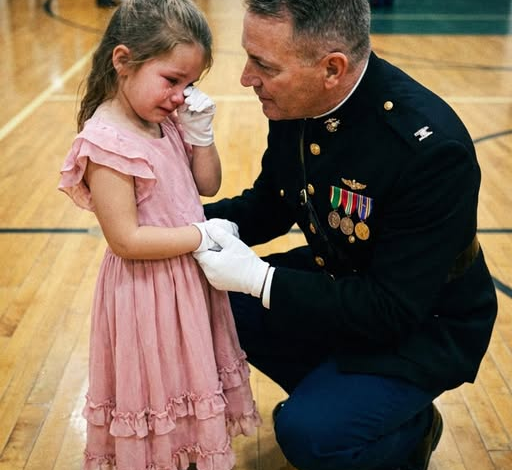
The doors opened with a sharp echo, and a group of Marines walked in—uniforms crisp, expressions steady. At their front was a commanding officer who approached us, then knelt in front of my daughter with a gentle smile.
He said her name like he already knew it.
He told her her dad had made a promise—that if he couldn’t be there one day, his unit would stand in for him. And then he handed her a letter.
My daughter opened it with trembling hands. As she read, her voice softened, but every word carried weight. Her father’s words. His love. His pride. His promise that even if he wasn’t there, he never truly left.
When she finished, there wasn’t a dry eye in the room.
One by one, the Marines stepped forward, introducing themselves, sharing small memories of Keith—how he talked about her constantly, how proud he was. They didn’t speak like strangers. They spoke like family.
Then one of them asked her to dance.
And just like that, the night shifted.
She laughed. She danced. She spun under the lights like she used to at home. Other kids joined in, parents followed, and the room filled with something lighter—something warm. The heaviness didn’t disappear, but it made space for joy.
At one point, someone placed a Marine cap on her head, and she stood there beaming, taller somehow, stronger. I realized then that this wasn’t just about filling an absence. It was about honoring a presence that still mattered.
Later, as the night wound down, the officer came over to me. He told me Keith had made them promise. That there was never any doubt they would show up if the moment came.
And they did.
When we left, my daughter held my hand tightly. She asked if we could come back next year.
I told her yes.
Outside, under the night sky, something felt different. The grief was still there—but it no longer felt like we were carrying it alone. Keith’s promise hadn’t been broken. It had simply taken a different form.
And for the first time since losing him, I felt it clearly—
We were still held.