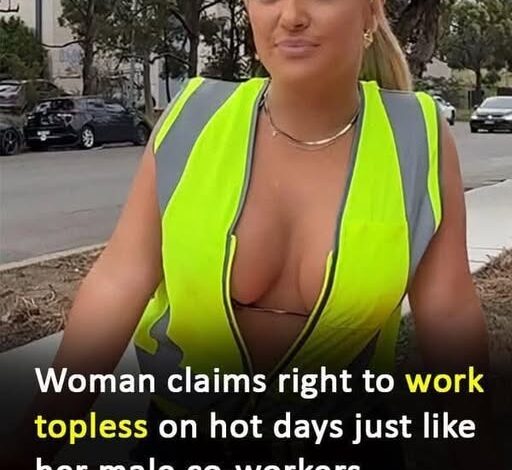
Shianne Fox didn’t just complain about the sweltering heat on the construction site; she challenged an unwritten set of rules that have governed male-dominated industries for decades. On sites where men’s bodies are considered the default and women’s bodies are often treated as distractions, Fox’s choice to go topless was a deliberate statement—about equality, personal comfort, and bodily autonomy. But while her actions sparked a viral frenzy, the reaction revealed a painful, underlying fracture: many women in trades feel her approach reinforces the very stereotypes they’ve spent years trying to dismantle.
For female tradespeople, the tension isn’t theoretical—it’s deeply personal. Many report being judged, doubted, or outright dismissed from the moment they set foot on a site. Jokes about their competence, sideways glances, and subtle microaggressions are daily realities. When someone like Fox goes viral for going topless, it can feel like a distraction—not from the heat, but from the harder, less glamorous work of reshaping workplace culture and demanding respect. The question these women face isn’t about clothing; it’s about credibility. And when public attention focuses on bodies rather than skills, it reinforces the old narrative: that women have to perform, prove, or explain themselves in ways men rarely do.
Yet Fox’s stance also raises broader questions about equality. Is gender parity achieved by doing exactly what men do, or by challenging long-held assumptions about what respect and professionalism look like for everyone? In an industry where the male-to-female ratio can be as high as 12:1, the stakes are high. Women aren’t just fighting for the right to wear what they want—they’re fighting for recognition, opportunity, and a sense of belonging in spaces where the culture has historically excluded them. Every action, viral or otherwise, sparks a conversation about who belongs and who defines the rules.
Some advocates argue that Fox’s choice, while controversial, has opened an important dialogue. By confronting norms head-on, she forces sites, supervisors, and even clients to confront their biases. The conversation isn’t just about modesty or clothing—it’s about systemic change. Respect and professional authority should not hinge on gender or appearance. And yet, the conversation is messy. For every person inspired by Fox’s defiance, there’s another woman who feels misrepresented or undermined, her skills overshadowed by sensational headlines and viral images.
Beyond individual reactions, there’s a cultural dimension at play. Trades have long celebrated toughness, endurance, and conformity to masculine norms. Any deviation—whether it’s style, behavior, or advocacy—can be perceived as a challenge to that culture. Women navigating these environments must weigh visibility against vulnerability: being seen can invite both admiration and scrutiny, progress and backlash. Fox’s actions, while empowering to some, highlight the precarious balance women in trades constantly negotiate between asserting themselves and managing the reactions of a predominantly male peer group.
At the heart of the debate is a profound question about equality: is it enough to be tolerated in male spaces, or is true equity about reshaping those spaces so women can thrive on their own terms? The discussion triggered by Fox’s topless workday isn’t merely symbolic. It’s a reminder that change in deeply ingrained systems is rarely comfortable, rarely straightforward, and often contested. The fight isn’t about shirts, exposure, or attention—it’s about power, agency, and the right to occupy workspaces without compromise.
Ultimately, Fox’s viral moment forces reflection on who defines professionalism, whose bodies are normalized, and whose authority is questioned. It underscores the ongoing challenges for women in trades, revealing that the struggle for equality is as much about cultural perception as it is about laws, policies, or numbers. And it reminds all workers—men and women alike—that inclusion, respect, and opportunity must be intentionally cultivated, not assumed. The conversation sparked by Fox isn’t just about one worksite, one viral video, or one wardrobe choice—it’s about redefining what it means to belong in spaces long dominated by a single narrative.