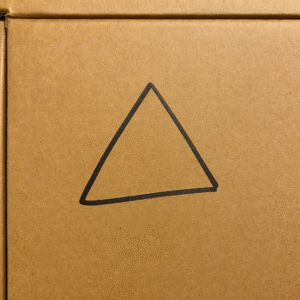
The Mystery Triangle Marked on a Package: Why Delivery Drivers Use Strange Symbols, What a Random Scribbled Triangle Actually Means, and How an Ordinary Doodle Sparked a Viral Wave of Fear, Curiosity, Assumptions, and Unexpected Lessons About Modern Deliveries

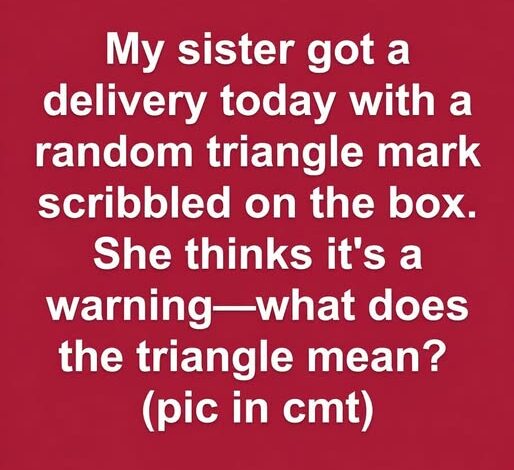
There are moments when something small and unexpected can feel far more significant than it really is. A simple mark, a strange detail, or a tiny irregularity can trigger a cascade of questions, especially in a world where we are constantly exposed to warnings, alerts, and stories that encourage us to stay cautious. What happened with that hand-drawn triangle on your sister’s package is a perfect example of how easily the ordinary can take on an air of mystery. It wasn’t just a shape—it was the uncertainty behind it that gave it weight. And in that moment, the mind did what it naturally does: it tried to make sense of something unfamiliar by imagining every possible explanation.
The truth, however, is far less dramatic and much more grounded in everyday reality. In the fast-moving world of deliveries, where thousands of packages are handled in tight timeframes, workers rely heavily on speed and efficiency. They don’t always have the luxury of carefully documenting every step in a formal way, so they create their own quick systems—marks, symbols, and shorthand that help them keep track of what’s been checked, sorted, or delivered. A triangle, in that context, is not a message meant for the recipient at all. It’s simply a tool, something functional and fleeting, used in the moment and forgotten just as quickly.
What makes situations like this interesting is not the symbol itself, but how we respond to it. Humans are naturally wired to notice patterns and assign meaning, especially when something feels out of place. A handwritten mark stands out because it feels personal. Unlike printed labels or barcodes, it looks intentional in a human way, as if someone paused and chose to leave it there for a reason. That alone is enough to spark curiosity—and sometimes concern. Add in the influence of social media, where similar stories circulate and amplify uncertainty, and suddenly a harmless scribble becomes something people across the country are questioning.
There’s also something deeper at play: a growing awareness of safety and security. People are more alert than ever to the possibility of scams, theft, or hidden signals, so even small details can feel like potential warnings. In that sense, your sister’s reaction wasn’t irrational—it was protective. She saw something unfamiliar and wanted to understand it. That instinct, while it can sometimes lead to overthinking, is also what helps people stay aware of their surroundings. The key difference lies in learning when to question and when to step back and consider simpler explanations.
When you look at the bigger picture, the triangle becomes almost symbolic in a different way—not as a warning, but as a reminder of how perception works. It shows how quickly uncertainty can grow when there’s a lack of clear information. It also highlights how much trust we place in routine. We expect packages to arrive clean, labeled, and predictable. When that pattern breaks, even slightly, it captures our attention immediately. But in reality, the delivery process is far less polished behind the scenes than most people imagine. It’s busy, fast, and sometimes messy, and small marks are just part of that environment.
What’s reassuring is that there is no hidden system targeting individuals, no secret symbols being used to mark homes, and no underlying threat connected to something as simple as a triangle drawn in pen. The overwhelming evidence—from delivery workers themselves and from company practices—points to the same conclusion: these marks are practical, temporary, and internal. They are not meant to communicate anything to the person receiving the package.
In a way, the entire situation turns into something unexpectedly meaningful. Not because the triangle had a hidden purpose, but because of the conversation it sparked. It encouraged curiosity, investigation, and ultimately understanding. It transformed a moment of unease into clarity—and even a bit of humor, especially when the next package showed up with a different shape.
And that might be the most valuable takeaway of all. Not every unusual detail is a cause for concern. Sometimes, it’s just a glimpse into the human side of systems we usually take for granted. A quick mark from a busy worker. A small imperfection in an otherwise automated process. A reminder that behind every package is a chain of real people making fast decisions in real time.
So in the end, the triangle didn’t carry a hidden message—but it did reveal something important. It showed how easily meaning can be created, how quickly questions can grow, and how reassuring simple answers can be once we find them.