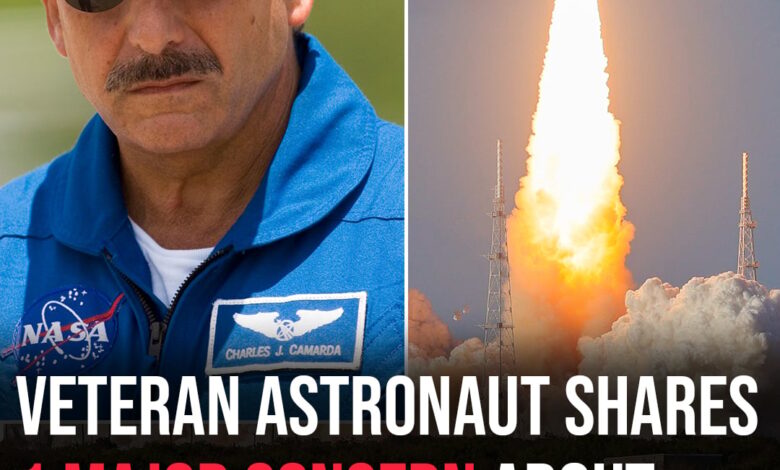
As Artemis II prepares to carry astronauts farther from Earth than any human mission in over half a century, the mood around it is understandably filled with excitement, pride, and a sense of historic return. But for Charles Camarda, that moment is inseparable from memory—specifically, the kind of memory that doesn’t fade with time. He doesn’t just remember the Columbia disaster as an event; he remembers the chain of decisions, the overlooked warnings, and the subtle cultural shifts that allowed risk to be reframed as acceptable.
What stays with him most isn’t only the foam that struck the wing—it’s the conversations that followed. The hesitation. The tendency to downplay uncertainty. The way questions became quieter as timelines pressed forward. In his view, tragedies like Columbia aren’t born from a single failure, but from an accumulation of small compromises—moments where concern is acknowledged but not fully acted upon.
That’s why, as Artemis II moves forward, his concern cuts deeper than technical specifications or mission milestones. Camarda isn’t sounding an alarm about exploration itself—he’s speaking about mindset. To him, the greatest danger isn’t a flaw in hardware, but a culture that becomes too comfortable, too confident, or too constrained to challenge itself. When bureaucracy layers over urgency, when dissent feels inconvenient, when success becomes expected rather than earned—that’s when risk quietly grows.
And yet, there’s no bitterness in his perspective. If anything, it’s rooted in belief. Camarda doesn’t doubt NASA’s capability—he believes in it deeply. His warning is not about stopping progress, but about protecting it. He sees Artemis not just as a mission, but as a test of whether the agency can reconnect with the principles that once defined its greatest achievements.
He often points back to the Apollo era—not with nostalgia, but with intention. That period wasn’t flawless, but it was driven by a culture where questioning was constant, debate was encouraged, and assumptions were relentlessly challenged. Engineers argued. Data was scrutinized. Nothing was taken for granted. That environment, he believes, is what made extraordinary success possible.
In today’s program, he sees both promise and pressure. The Space Launch System, while powerful, incorporates elements of legacy technology—systems that carry both experience and age. Orion, designed for deep-space travel, has already faced its share of technical hiccups, including something as seemingly minor—but symbolically important—as a malfunction in its life-support systems. These are not reasons, in his eyes, to criticize the mission. They are reminders. Reminders that spaceflight is unforgiving, that even small issues matter, and that no system is beyond scrutiny.
Because in space, there are no second chances. There is no margin for assumption. Every decision, every overlooked detail, every unasked question carries weight.
For the four astronauts preparing to fly Artemis II, Camarda’s thoughts turn personal. He understands what it means to trust a system, to sit atop a vehicle built by thousands of people, and to believe that every possible risk has been accounted for. Their courage is not in question. What matters, to him, is whether that courage is matched by an environment that earns it—one that invites scrutiny rather than resists it, that values dissent as much as agreement.
His message, ultimately, is not one of fear, but of responsibility. He’s asking NASA—and everyone involved—to remain vigilant, not just in engineering, but in culture. To ensure that no concern is too small to be voiced, no question too inconvenient to be explored, no assumption too comfortable to be left unchallenged.
Because history, as he knows too well, doesn’t repeat itself in obvious ways. It echoes—in habits, in decisions, in the quiet spaces where doubt is set aside.
And yet, there is hope in his words. He believes the agency can rise to meet this moment. That Artemis can be more than a return to the Moon—it can be a return to a mindset where excellence is not assumed, but demanded. Where success is built not just on innovation, but on humility and discipline.
As humanity prepares to step once again into deep space, Camarda’s perspective lingers as both a caution and a guide. Exploration will always carry risk. But how that risk is managed—how it is questioned, challenged, and respected—will determine whether the mission becomes a triumph, or a lesson written too late.
For him, the goal is simple, even if the path is not: that when Artemis II leaves Earth, it carries not only ambition and courage, but the full weight of everything history has already taught us—and the willingness to listen before the universe forces us to learn again.