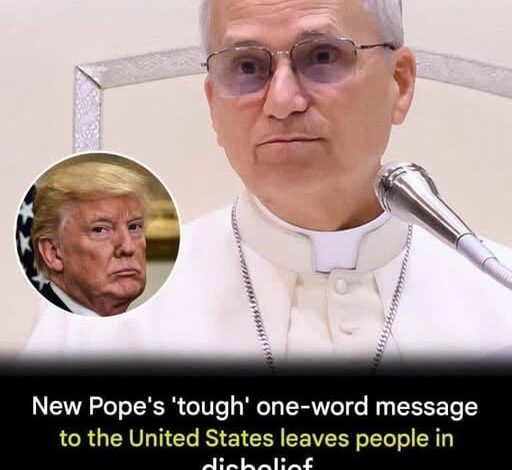
In a time shaped by constant political noise and endless arguments echoing across screens, it was striking that a single word could command such attention. Yet that is exactly what happened when Pope Leo XIV—remarkable not only for his position but for being the first pontiff born in Chicago—responded to a question about the state of the American spirit with one simple answer: “Many.”
At first glance, the word seemed almost too small to carry meaning. It felt incomplete, open-ended, even puzzling. But as it spread across headlines, social media, and conversations, people began to hear something deeper within it. It didn’t feel like a vague response—it felt like a reflection.
For many Americans, “Many” captured the overwhelming complexity of the moment. It hinted at the many divisions shaping public life, the many voices competing to be heard, and the many struggles that often go unseen. It pointed to the growing sense that the country is not defined by one single story, but by countless overlapping realities—some hopeful, others deeply painful.
What gave the word its weight was not just its meaning, but the man who spoke it.
Pope Leo XIV does not observe the United States from a distance. His understanding of the country is personal, shaped by lived experience rather than abstract analysis. He knows its contradictions—the optimism that drives it forward and the tensions that pull it apart. His leadership has already shown a willingness to speak directly about issues of dignity, responsibility, and compassion, particularly when it comes to those living on the margins.
So his answer was not dismissive. It was deliberate.
“Many” became less of a conclusion and more of an opening—an invitation to look closer. To recognize that the nation’s challenges cannot be reduced to simple explanations or quick fixes. That behind every headline are real people, each carrying their own story, their own burden, their own hope.
And yet, the moment did not end there.
As he moved through the crowd, he followed that single word with something more familiar, but no less meaningful: “God bless you all.”
Those four words softened the sharpness of his earlier response. They didn’t erase the critique—they balanced it. Together, the two statements revealed something essential about his approach: a leadership style grounded in both honesty and care. A willingness to name difficult truths, while still holding space for compassion.
It is becoming clear that his papacy will not rely on distant, formal language or carefully neutral statements. Instead, he seems intent on speaking in ways that are direct, human, and at times uncomfortable. Not to divide, but to awaken. Not to condemn, but to challenge.
In that brief exchange, he offered more than commentary—he offered a perspective.
That the United States is not a single, unified experience, but a collection of many realities. That understanding requires listening, not just reacting. And that even in a time of tension and uncertainty, there remains the possibility of something better—if people are willing to see clearly and respond with empathy.
As the word continues to circulate, it lingers not as a slogan, but as a question.
What does “Many” mean to each person who hears it?
Because within that question may lie the beginning of something deeper—not just recognition, but change.