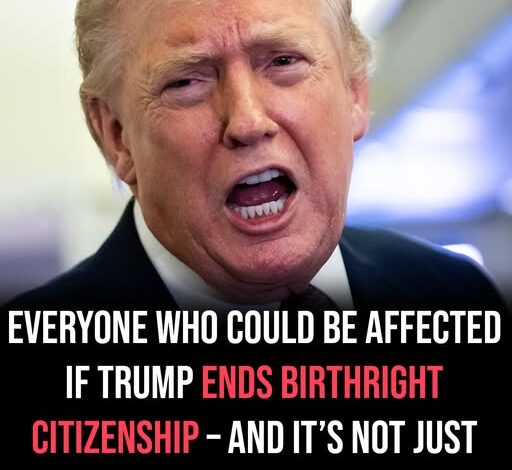
In a move that has reverberated across nearly every facet of American society, the very concept of what it means to be “American” is now under intense scrutiny. On April 3, 2026, the political landscape was shaken when former President Donald Trump introduced a highly controversial executive order aimed at dismantling birthright citizenship—a foundational principle embedded in the 14th Amendment. While public discourse has largely centered on undocumented immigration, the broader implications are far more sweeping. The proposal could potentially affect millions of children born to legal residents, international students, and skilled foreign workers, fundamentally altering the long-standing understanding of citizenship in the United States.
For over a century and a half, the 14th Amendment has served as a cornerstone of American identity, establishing that anyone born on U.S. soil is automatically granted citizenship. This principle has been widely regarded as absolute and non-negotiable. However, the executive order challenges that interpretation, proposing that children born to parents who are either undocumented or temporarily residing in the country on legal visas would no longer qualify for automatic citizenship. Under such a framework, even children born to highly skilled workers, international students, or short-term visitors could be excluded—marking a profound shift in how belonging is defined in the United States.
The potential consequences of this policy are immense. According to available data, millions of individuals could be impacted, including those who might face uncertain legal status or even statelessness. Beyond undocumented populations, the measure introduces new concerns for families who have legally contributed to American society through work, education, and innovation. The ripple effects would extend beyond immigration policy, raising critical questions about equality, human rights, and the foundational promises of the nation.
Legal resistance has been swift and forceful. Attorneys general from numerous states have filed challenges, arguing that an executive order cannot override constitutional guarantees. The issue has rapidly escalated to the Supreme Court, where arguments are now underway. In a historic and unusual development, Trump himself attended the proceedings, underscoring the magnitude of the case. The courtroom has become a focal point for a broader national debate—one that extends beyond legal technicalities into deeper questions about identity, fairness, and the future direction of the country.
Public rhetoric surrounding the policy has further intensified the controversy. Supporters argue that birthright citizenship has been misused and requires reform, while critics warn that such changes could dismantle one of the most inclusive principles in American law. The debate has become not only legal but philosophical, touching on competing visions of national identity and the purpose of constitutional protections.
As the nation awaits a judicial decision, uncertainty continues to grow. A ruling in favor of the executive order could represent one of the most significant shifts in civil rights in modern U.S. history, potentially creating a system where a child’s rights are determined by their parents’ legal status. Families across the country now face an unsettling possibility: that birth on American soil may no longer guarantee citizenship. At stake is more than policy—it is the future of a defining national ideal, one that has long symbolized inclusion, opportunity, and the promise of belonging.