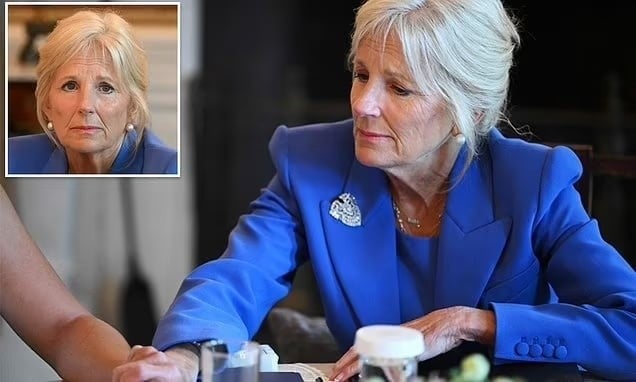
For the first time, the expectations surrounding a First Lady seem to stretch beyond ceremony and into something far more immediate, shaped by the realities of a world in conflict. Jill Biden’s presence in Kyiv has been interpreted by many not simply as symbolic support, but as a reflection of a broader shift in how influence, diplomacy, and visibility can intersect during moments of global tension.
Her earlier visits to Ukraine—especially those made under difficult and uncertain conditions—carried weight precisely because they blurred traditional boundaries. They suggested that the role of a First Lady, while not formally political, can still serve as a channel for reassurance, solidarity, and human connection in places where official policy alone may feel distant.
What stands out is not just the setting, but the tone she brings to it. Jill Biden has long maintained a parallel identity outside the White House, continuing her work as an educator even while occupying one of the most visible roles in the country. That insistence on normalcy—grading papers, teaching, staying grounded—signals a kind of continuity that contrasts sharply with the instability of war zones and geopolitical strain.
In that sense, her presence carries a different kind of message. Not one defined by power or command, but by persistence. By showing up. By maintaining ordinary commitments in extraordinary circumstances.
Reactions to her involvement have reflected this duality. Some see it as a meaningful extension of soft diplomacy—an effort to humanize alliances and reinforce shared values. Others view it through a more cautious lens, questioning how far symbolic roles should extend into active geopolitical spaces. Either way, it highlights how evolving global conditions are reshaping even the most established traditions.
In a conflict often defined by military strategy and political negotiation, her role—formal or informal—leans toward something quieter but no less significant: presence, empathy, and continuity. It suggests that alongside policy and power, there is still space for a different kind of engagement—one rooted not in authority, but in connection.
And perhaps that is what makes it resonate. Not because it redefines the position entirely, but because it expands the way people imagine what influence can look like when the world feels uncertain.