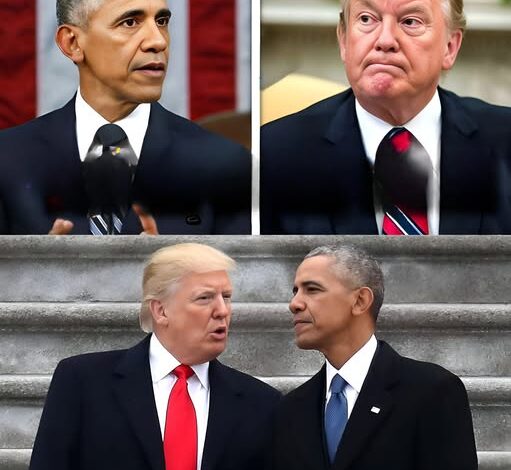
What started as a routine cable interview quickly turned into something far more telling—a snapshot of how modern politics now operates in real time. Trump’s criticism of Obama wasn’t simply a reflection on past decisions; it was a calculated moment designed for an audience that no longer watches passively, but reacts, clips, shares, and reframes instantly.
In today’s media environment, every word carries multiple lives. What is said on air is only the beginning. Within minutes, segments are isolated, headlines are formed, and narratives begin to compete. Supporters interpret the moment as authenticity—direct, unfiltered, unapologetic. Critics see it as another example of eroding civility and political decorum. And somewhere in between, millions of viewers replay the exchange, analyzing tone, expression, and intent, searching for something definitive in a space that rarely offers clarity.
But the deeper significance lies in how the moment travels.
Live television and social media are no longer separate stages—they function as one continuous loop. A comment made in a studio becomes content, then currency, then a tool. Context compresses. Nuance fades. What remains is impact: who said what, how it felt, and how quickly it can be amplified.
In that environment, conflict isn’t just inevitable—it’s valuable.
Moments of tension generate attention, and attention drives visibility. The sharper the exchange, the faster it spreads. This dynamic shifts how political communication is shaped. It’s no longer just about persuading through policy or argument, but about commanding presence within a crowded, fast-moving information stream.
That’s what made the interview feel less like a deviation and more like a reflection of a broader trend.
Leadership today is judged across multiple dimensions at once—not only by decisions made behind closed doors, but by how those decisions are presented, contested, and remembered in public spaces. Performance and perception are intertwined. A single exchange can reinforce loyalty, deepen division, or reshape narratives far beyond its original context.
And perhaps most importantly, it highlights the role of the audience.
Viewers are no longer just observers—they are participants in how moments evolve. What they choose to share, amplify, or challenge becomes part of the story itself. In that sense, political discourse isn’t just happening on screens; it’s being co-created in real time.
The interview, then, wasn’t just about two political figures or a single exchange. It was a reminder of how quickly meaning can shift, how easily context can be lost, and how powerful the modern media cycle has become in shaping what people remember.
Not as a full conversation—
but as a moment, distilled, repeated, and reinterpreted until it becomes something larger than the original words.