I Thought My Husband Died — Then Three Years Later He Moved Into the Apartment Next Door With Another Woman and a Child

I buried my husband one day… and my daughter the next.
Grief doesn’t come in waves the way people say. Sometimes it comes like a collapse—sudden, total, leaving nothing standing. In less than forty-eight hours, my entire life folded in on itself. And three years later, just when I had finally learned how to exist inside the ruins, he came back.
Not as a memory.
Not as a ghost.
But as a man wearing my husband’s face… living right next door.
And that was only the beginning of the lie.
They buried Ron in a closed casket.
At the time, I thought it was mercy. Protection. Everyone spoke in soft, careful tones, like I might shatter if they used the wrong word.
“The accident was too severe.”
“You don’t want to remember him like that.”
“Hold onto the good version of him.”
No one asked what I wanted.
I was eight months pregnant, standing beside a coffin I wasn’t allowed to open, saying goodbye to a man I wasn’t allowed to see. I remember gripping the edge of the casket as they lowered it, feeling something deep inside me resisting the finality of it all.
It felt wrong.
But grief makes you doubt your own instincts. It makes you obedient.
So I let them close it. I let them bury him.
And by the next morning, my daughter stopped moving.
The doctors said it was shock. Trauma. That my body had simply… given up.
I don’t remember signing the papers. I don’t remember the second funeral clearly either. Just the unbearable quiet afterward. Two graves. Two names. One life erased.
Everything we had planned—every version of the future I had imagined—was gone.
Three years later, I lived in a different city, in a third-floor apartment that didn’t know my name.
No pictures on the walls. No keepsakes. Nothing that could accidentally pull me backward.
I worked at a dental office, where days were measured in appointments and routine. Cleanings at nine. Root canals at eleven. Insurance calls in between. It was safe. Predictable. Forgettable.
And when I came home, there was silence.
I told myself I chose that apartment because of the light. The big windows. The way the sun filled the space in the afternoon.
But the truth was simpler.
There were no memories there.
And I had learned that memories were dangerous.
I survived by not looking back.
Until the noise started.
It was a Sunday—quiet, ordinary. I was at the sink, rinsing a plate, when something heavy scraped along the stairwell wall outside. The sound was sharp, jarring, out of place.
Then voices.
“Careful with the corner,” a man said.
A woman laughed softly.
I glanced out the window.
A family was moving in.
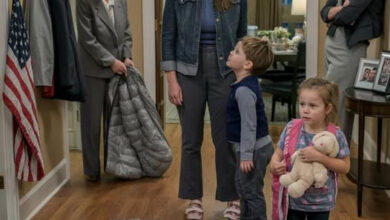
The woman stood below, directing movers with easy confidence, a clipboard tucked under her arm. A toddler wandered dangerously close to the steps, clutching a worn pink rabbit.
And then there was the man.
He lifted a couch like he’d done it a hundred times before, steady and controlled. For a second, something in my chest twisted—a quiet, painful echo of what my life should have been.
That could have been us.
Ron and me.
A child. A home. A future that made sense.
Then he looked up.
And the world stopped.
It wasn’t resemblance.
It wasn’t similarity.
It was him.
Same eyes. Same mouth. Same careless way of pushing his hair back from his forehead.
Three years older, maybe. A little more worn. But unmistakable.
My husband.
Alive.
I stepped back so fast I knocked a glass off the counter. It shattered against the floor, but I barely heard it.
“Get it together,” I whispered to myself, though my body had already stopped listening.
Footsteps echoed up the stairwell.
Before I could stop myself, I was in the hallway.
He came into view carrying the little girl on his hip. She rested against him like she belonged there, like she had always belonged there.
He stopped at the apartment next to mine, pulling keys from his pocket.
This wasn’t possible.
It couldn’t be.
And yet—
“Excuse me,” I heard myself say.
He turned, distracted. “Yeah?”
Up close, the illusion disappeared.
This wasn’t a stranger who looked like Ron.
This was Ron.
Or someone who had stolen every detail of him.
“Do you know anyone named Ron?” I asked, my voice carefully steady.
Something in his expression tightened.
“No,” he said quickly. “Katie, let’s go inside, baby.”
Katie.
The name hit me like a physical blow.
“That’s my name,” I said.
For a fraction of a second, something flickered in his eyes.
Recognition.
Fear.
Then it was gone.
I stepped closer.
“Your hand,” I whispered.
He froze.
Two fingers missing.
The same two Ron lost when he was ten years old, after trying to light fireworks behind his uncle’s garage while his mother screamed at him to stop.
There was no explanation left.
No doubt.
“Ron,” I said, my voice breaking for the first time. “Is that really you?”
The little girl clung tighter to him.
And then a woman’s voice came from the stairs.
“Is there a problem?”
Everything unraveled after that.
Truth doesn’t come cleanly. It doesn’t arrive all at once. It fractures, spills, resists.
But eventually—it comes.
He hadn’t died.
He had disappeared.
Debt. Lies. Fear. A plan that spiraled into something irreversible.
A closed casket wasn’t just grief.
It was concealment.
A cover.
A way to bury a lie so deep no one would think to dig it back up.
While I mourned him, he started over.
While I lost our child, he built a new life.
While I fought collectors, signed papers, buried everything we had… he was somewhere else, calling himself free.
And worst of all—
He knew.
He knew what his disappearance had done to me.
And he stayed gone anyway.
The investigation didn’t take long after that.
Documents fell apart under scrutiny. Signatures didn’t match. Stories contradicted each other.
The funeral had been arranged.
The death had been staged.
The truth had been buried intentionally.
Not just by him—but by people who helped him disappear.
When the police came, I didn’t feel rage.
Not the kind I expected.
I felt something quieter.
Heavier.
Clarity.
Carla—the woman he built his new life with—stood in my apartment days later, her daughter clinging to her leg.
“I didn’t know,” she said, her voice raw.
“I believe you,” I told her.
Because I did.
We were both victims of the same lie—just at different times.
Ron was arrested.
So was the woman who helped him fake his death.
Charges stacked quickly—fraud, falsified documents, identity deception.
But none of it felt like revenge.
Because nothing could give me back what I lost.
The morning after they took him away, the building was quiet again.
Still.
For the first time in years, it didn’t feel empty.
It felt… open.
Like something had finally been returned—not love, not the past, not even closure.
Just truth.
And sometimes, truth is the only thing strong enough to break a lie this big.
And for the first time in three years…
I wasn’t surviving anymore.
I was free.