We Now Understand What He is Facing, Bruce Willis Family Shares Emotional Update That Hit Fans Hard

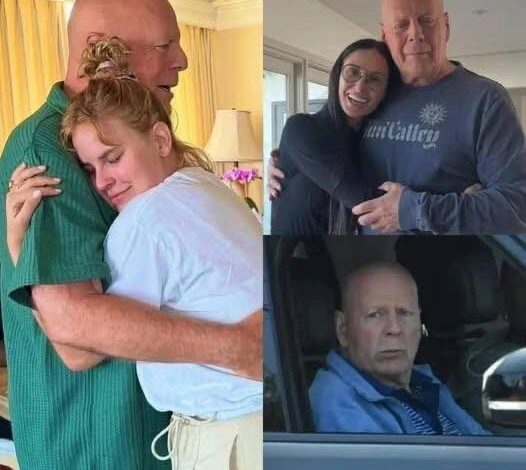
For decades, Bruce Willis stood as a symbol of strength on screen—a defining presence in action films, known for his sharp wit, quiet intensity, and unforgettable roles. Whether portraying hardened heroes or delivering moments of humor, he carried a natural confidence that audiences instantly connected with.
But in recent years, the story surrounding him has shifted—from performance to something far more personal.
And far more difficult.
After stepping away from acting, his absence was felt. Fans began to notice the silence, asking questions, sensing that something had changed even before they understood what it was.
In 2022, that uncertainty was replaced with clarity.
His family shared that he had been diagnosed with aphasia—a neurological condition that affects communication, including speech, understanding, and the ability to process language.
The news reframed everything.
What had once appeared to be a quiet retirement was, in reality, the beginning of a serious and life-altering challenge.
From the start, his family chose openness over speculation.
Rather than allowing rumors to define the narrative, they spoke directly and honestly, offering updates that balanced transparency with respect for his privacy. Among them, his daughter Rumer Willis became a steady and compassionate voice, helping translate their personal experience into something the public could understand.
Her message centered on something simple, yet deeply meaningful:
Gratitude.
The response from fans around the world was immediate and overwhelming—filled with memories, messages, and reflections from people who had grown up watching him, who felt a personal connection not just to his work, but to the presence he brought into their lives.
But alongside that gratitude came a harder truth.
Over time, his condition progressed.
And with that progression came a more specific diagnosis: frontotemporal dementia—a form of dementia that affects behavior, personality, and language rather than memory in its early stages.
For someone whose career depended on timing, voice, and emotional precision, the impact is profound.
Yet this story is not defined solely by loss.
It is also about adaptation.
About connection.
And about the quiet strength that emerges when life changes in ways no one expects.
Since sharing his diagnosis, his family has remained close—standing beside him not only as caregivers, but as a unified support system. His wife, his children, and even his former partner Demi Moore have stayed present, reflecting a bond that extends beyond traditional definitions of family.
Their approach has remained steady.
They have not hidden the reality.
They have chosen to help people understand it.
And that choice has made a difference.
Because conditions like frontotemporal dementia are often misunderstood. They do not follow a simple or predictable path, and they affect not only the individual but everyone around them in deeply personal ways.
By sharing their journey, his family has done more than provide updates—they have created awareness.
They have opened space for empathy.
And they have given people a clearer understanding of what it truly means to live with such a diagnosis—not just medically, but emotionally.
Behind the public statements, there is a quieter reality unfolding.
One that exists away from cameras and headlines.
A life shaped by small adjustments.
Daily changes.
Moments that require patience, presence, and a different kind of strength—the kind that isn’t visible on screen.
For those closest to him, this is not a single event.
It is an ongoing journey.
One that evolves, day by day.
And perhaps that is why this story resonates so deeply.
Because it reflects something universal.
The unpredictability of life.
The way roles can shift—from independence to dependence, from public figure to private individual.
And the way families respond when everything changes.
The messages from his family have never focused only on what has been lost.
They have also emphasized what remains:
Connection.
Support.
Presence.
These are not abstract ideas—they are the foundation of how they continue forward.
Fans, too, have become part of that support.
Through tributes, messages, and shared memories, they have created a sense of collective care—turning distance into something more meaningful. For someone who spent decades entertaining millions, that response carries real significance.
It reflects the impact he made—not just through the characters he played, but through the way he was experienced by audiences around the world.
As updates continue, they remain grounded in the same tone—honest, respectful, and real.
There are no dramatics.
No exaggeration.
Just truth.
And that truth matters.
Because it allows people to understand—not everything, but enough to see beyond the headlines.
Today, Bruce Willis’s story is no longer defined only by the roles that made him famous, though those remain an essential part of his legacy.
Now, it is defined by something quieter.
A shift from performance to presence.
From public recognition to private resilience.
And in that shift, there is something deeply human.
Something worth paying attention to.
Not for spectacle—
but for what it reveals about illness, about family, and about a kind of strength that doesn’t appear in films, but shows itself in the way people continue to stand by one another when everything changes.
In the end, the message from his family has remained clear:
Gratitude for the support.
Honesty about the journey.
And a commitment to face whatever comes next—together.
Because even as life changes,
one thing has not:
He is not facing it alone.