The Silence Heard Round the World, Why the Artemis II Crews Frozen Response to Trump is Being Called the Most Cringe-Worthy Moment in NASA History

Space is naturally silent—but on April 7, 2026, a different kind of silence took hold. One filled not with emptiness, but with tension.
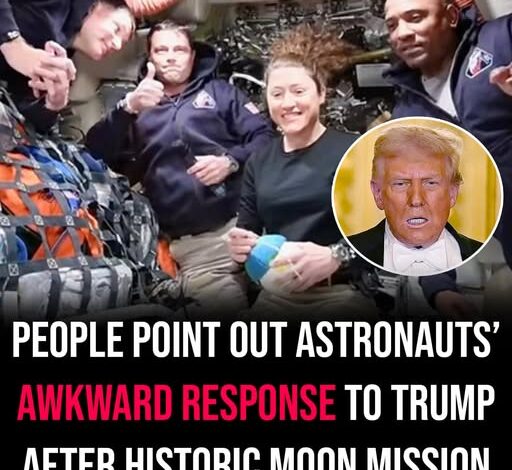
As the Artemis II crew completed their historic journey around the far side of the Moon, the moment was meant to symbolize humanity’s confident return to deep space. Four astronauts—Reid Wiseman, Victor Glover, Christina Koch, and Jeremy Hansen—floated inside the Orion capsule, framed by the stark beauty of the lunar surface below them. Millions watched live, witnessing what should have been a seamless blend of science, achievement, and national pride.
A ceremonial call with the Oval Office was scheduled—routine in structure, but monumental in context.
The President’s voice came through the comms, offering praise for the crew’s courage and drawing comparisons to legendary explorers. The speech stretched on, weaving through familiar themes and even touching on a sports analogy about anticipating the future—“skating to where the puck will be.”
The astronauts waited.
Polished. Patient. Professional.
Floating microphones drifted gently between them in zero gravity as they listened.
Then the speech ended.
And everything stopped.
After a brief, courteous response from Jeremy Hansen, the line fell quiet.
At first, it felt like a normal delay—the kind expected when communicating across hundreds of thousands of miles. But seconds stretched into something heavier. Longer. Noticeable.
Then uncomfortable.
The crew remained still, their expressions composed but tightening at the edges. They exchanged brief glances—subtle, but telling. In a live broadcast, every second felt amplified. What might have passed unnoticed on Earth became impossible to ignore in space.
A minute of silence.
No follow-up. No sign-off. No confirmation.
Just four astronauts suspended between worlds—waiting.
Online, the moment ignited instantly.
Clips of the “frozen” exchange spread across social media within minutes. Interpretations flooded in just as quickly. Some saw quiet defiance—a subtle, unspoken reaction to political rhetoric. Others pointed to technical failure, a communications breakdown stretched beyond expectation.
But regardless of interpretation, the visual impact was undeniable.
In a moment designed to inspire, the silence lingered instead.
It was Mission Commander Reid Wiseman who finally broke it.
Reaching out, he steadied the drifting microphone.
“Mr. President, are you still with us?”
His voice cut through the tension, grounding the moment.
After a delayed response, nervous laughter followed—human, relieved, necessary. Wiseman added a light remark about the “long-distance call” to the Moon, attempting to ease the atmosphere and restore balance.
Eventually, the call ended.
But something had already shifted.
Official explanations pointed to communication latency—an expected challenge in deep-space transmissions, where signals travel vast distances and rely on relay systems across multiple continents. NASA cited a temporary relay issue, a rare but plausible cause for the unusually long delay.
Yet for many, the technical explanation didn’t fully erase the impression left behind.
The moment became something else entirely—a reflection of how even the most advanced missions remain deeply human.
Observers dissected every detail: the astronauts’ posture, their expressions, the subtle tension in their stillness. Supporters blamed infrastructure. Critics read meaning into silence. Others simply recognized something universal—a conversation that didn’t land, stretched across an impossible distance.
In the end, Artemis II remains a monumental success.
A critical step toward returning humans to the Moon—and beyond.
But history is often shaped not only by triumphs, but by moments that feel unexpectedly real.
And for many watching, the most memorable image wasn’t the Moon’s distant surface or the brilliance of the mission itself.
It was four astronauts—weightless, composed, and waiting—
caught in a silence that felt louder than anything space had to offer.