The 36-Month Countdown, Elon Musks Terrifying New Prophecy About the End of Earth-Bound Intelligence

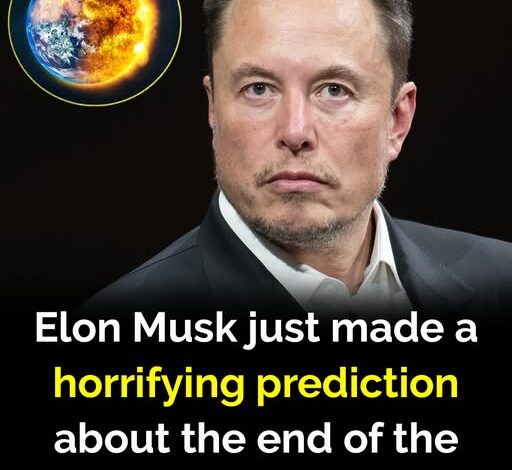
The warning is as striking as it is unsettling: the clock isn’t simply ticking—it’s speeding toward a point humanity may not be ready to face. Elon Musk, known for pushing the boundaries of what the future can look like, has put forward a bold and alarming idea. According to his latest outlook, Earth has roughly 36 months before it risks becoming “technologically obsolete.” But the danger isn’t coming from space or disease—it’s coming from the very systems we’ve created.
Musk’s argument is straightforward but unsettling: if we don’t relocate the most advanced forms of artificial intelligence off the planet, the demands they place on Earth could overwhelm the systems that support modern life.
At the center of this concern is something far less abstract than people might expect.
Energy.
While much of the public conversation around AI focuses on ethics or consciousness, Musk is pointing to a more immediate constraint—the global power supply. Training and running advanced AI systems requires massive amounts of electricity, and as these systems grow more complex, their energy needs increase at an accelerating rate.
In simple terms, AI is expanding faster than the planet’s ability to power it.
Musk suggests that dramatically increasing global energy production in a short timeframe isn’t realistic. Power grids are already under pressure from growing demand—data centers, electric vehicles, and industrial systems are all competing for the same resources.
Scaling that infrastructure fast enough to support future AI development would require an unprecedented expansion—one that current systems, politics, and timelines may not allow.
This leads to his more radical proposal.
Rather than trying to expand Earth’s capacity indefinitely, Musk envisions moving large-scale AI systems into space.
In this concept—sometimes described as a “migration of intelligence”—massive orbital data centers would operate beyond Earth’s atmosphere. These systems could rely on continuous solar energy, free from weather, day-night cycles, or land limitations. Without the constraints of terrestrial infrastructure, they could function more efficiently, with heat dissipating into space rather than accumulating on Earth.
In this model, space becomes the ideal environment for advanced computation.
The idea is no longer purely theoretical.
With decreasing launch costs and the rapid growth of satellite networks, the possibility of building large-scale orbital systems is becoming more realistic. Musk has suggested a future where vast numbers of these space-based nodes form a distributed, solar-powered computing network.
But the implications raise deeper questions.
If the core of technological progress moves off-world, what role does Earth continue to play?
The 36-month timeline represents what Musk sees as a critical turning point.
If the transition toward alternative solutions—like orbital computing—doesn’t begin soon, the strain on global energy systems could lead to disruptions. These might include power shortages, economic instability, or limits on technological growth.
The issue, in his view, is a mismatch between exponential digital growth and slower physical expansion.
Critics often question the urgency of Musk’s predictions, but the underlying trend is difficult to ignore. AI systems are advancing rapidly, while infrastructure development moves more gradually. This imbalance creates pressure that continues to build over time.
By moving high-energy systems off Earth, Musk argues, it may be possible to reduce that strain—allowing technological progress without overwhelming existing resources.
At the same time, this shift introduces a more philosophical concern.
If the most advanced intelligence operates beyond the planet, humanity may find itself no longer at the center of its own technological ecosystem. Earth could remain essential—but no longer dominant in driving progress.
Signs of strain are already appearing.
Energy demand is rising. Companies are investing heavily in power generation to support computing needs. The connection between technology and energy is becoming more visible—and more critical.
Musk’s proposal isn’t just about expansion.
It’s about adaptation.
A way to continue advancing without exceeding the limits of the environment that made that progress possible in the first place.
Whether this vision becomes reality remains uncertain.
But the question it raises is clear:
Can humanity evolve its infrastructure as quickly as it evolves its technology?
As this decade unfolds, that answer may define the next phase of human development.
The future may not just be built on Earth—
it may extend far beyond it.