Marjorie Taylor Greene demands Trump removed under 25th Amendment after chilling Iran threat

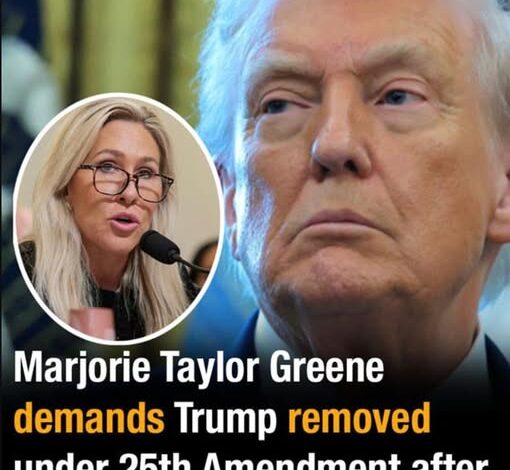
A sitting president openly speculating about the destruction of an entire civilization is not just provocative rhetoric—it marks a threshold that even some of his most loyal political allies appear unwilling to cross. When a figure like Marjorie Taylor Greene—who has historically stood firmly in Trump’s corner—publicly entertains the idea of invoking the Twenty-fifth Amendment, it suggests something deeper than routine political disagreement. It points to an undercurrent of concern within his own ranks: a growing unease about whether the immense authority tied to the presidency is being exercised with sufficient clarity, stability, or restraint.
This moment feels less like a typical partisan clash and more like a signal flare from within the system itself. The Twenty-fifth Amendment, after all, is not a casual political tool—it is a constitutional mechanism designed for extreme circumstances, when a president is perceived as unable to fulfill the duties of the office. For it to even enter the conversation among allies underscores how seriously some are interpreting the tone and implications of his recent remarks.
At nearly the same time, however, Trump appeared to pivot—at least temporarily—toward de-escalation. He agreed to a conditional two-week ceasefire with Iran, framing it as a strategic pause after claiming that U.S. military objectives had already been achieved. The announcement included assurances that vital shipping routes through the Strait of Hormuz would reopen, coordinated in part with Iranian authorities. For global markets and geopolitical observers, this offered a brief moment of relief, a narrow window in which tensions might cool rather than spiral.
But that contrast—between language hinting at annihilation and actions suggesting restraint—is precisely what makes the situation so unsettling. It creates a sense of unpredictability that is difficult for allies, adversaries, and citizens alike to interpret. Is this calculated brinkmanship, a deliberate effort to project strength through extreme rhetoric while quietly pursuing de-escalation behind the scenes? Or does it reflect something less controlled—a volatile approach to power where messaging and intent are not fully aligned?
The stakes, of course, are enormous. The presidency carries with it the authority to make decisions that can reshape global stability in an instant. When the signals coming from that office appear contradictory or erratic, it raises broader questions about the resilience of institutional safeguards. How strong are the guardrails designed to ensure measured decision-making? And what happens when those guardrails are tested not just by external crises, but by internal uncertainty?
In this uneasy space between escalation and restraint, the world is left watching closely. Markets fluctuate, diplomatic channels strain, and political allies begin to hedge their positions. What might once have been dismissed as rhetorical excess now feels like something more consequential—an indicator that the boundaries of presidential power, and the confidence in those who wield it, are being quietly but profoundly tested.