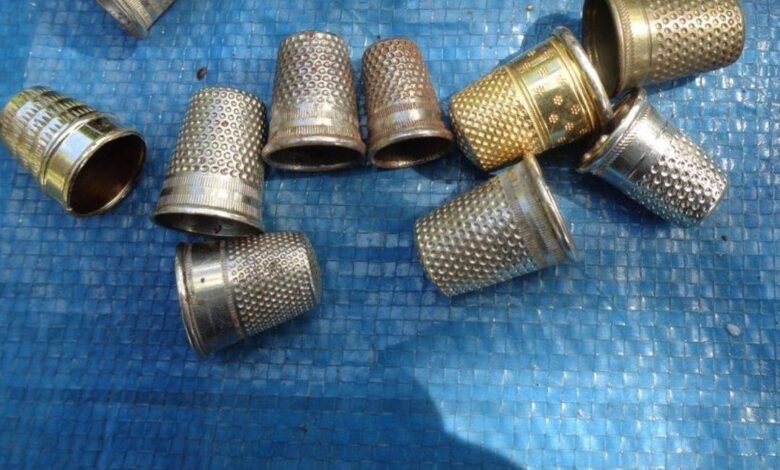
A thimble might be one of the smallest tools in a sewing kit, but its importance is anything but minor. Worn on the finger—most often the middle finger, though sometimes the thumb—it acts as a protective barrier between skin and needle. When pushing a needle through fabric, especially thicker materials or multiple layers, a thimble allows you to apply firm, controlled pressure without the risk of painful pricks. For anyone who sews regularly, it quickly becomes an essential companion, turning a delicate task into something smoother and more efficient.
Beyond protection, a thimble also improves precision. With a secure surface to press against, stitches can be guided more accurately, helping maintain even spacing and consistency. This added control is particularly useful in detailed handwork, where steady movement and accuracy matter just as much as speed.
Thimbles come in a surprising variety of styles, reflecting both their practical use and their long history. Some are simple and functional, with smooth surfaces, while others feature small dimples or ridges designed to grip the needle and prevent slipping. Materials vary widely as well. Traditional thimbles were often made from leather, offering flexibility and comfort. Today, metal versions—such as steel or brass—are common for their durability, while plastic and resin options provide lightweight, affordable alternatives for casual use.
The word “thimble” itself has an interesting origin, believed to come from the term “thumb-bell,” referring to early designs that were worn on the thumb and shaped like a small bell. This simple tool has been part of human craftsmanship for thousands of years. Archaeological findings show that ancient cultures, including those in China and the Roman Empire, crafted thimbles from materials like bone, bronze, and ivory. Over time, particularly in Europe during the 16th and 17th centuries, thimbles evolved into finely made objects, sometimes crafted from silver or gold. These were not only practical tools but also cherished items, often given as gifts or passed down through generations.
Today, different types of thimbles are designed to suit specific sewing styles. Closed-top thimbles offer full protection for the fingertip and are widely used for general sewing. Open-top versions allow more flexibility and are ideal for those with longer nails. Leather thimbles provide comfort during long sewing sessions, while adjustable ring thimbles—worn like a band rather than covering the fingertip—are especially popular among quilters for their versatility.
No matter the design or material, the purpose of the thimble remains unchanged. It is a small but powerful tool that supports the art of sewing, offering protection, control, and confidence with every stitch.