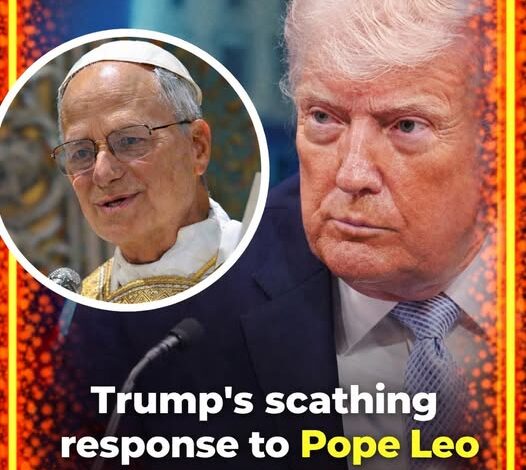
Trump’s recent post went beyond a simple policy disagreement and took on the tone of a personal and symbolic rupture. By deriding Pope Leo XIV as “WEAK on Crime” while simultaneously elevating the Pope’s MAGA-aligned brother, Trump appeared to draw a stark line: even the leader of the Catholic Church is not exempt from his expectation of political loyalty. In framing the Pope’s moral positions as weakness, Trump recast a theological and ethical debate into a test of allegiance, where deviation from his worldview is treated as failure. He also defended his own record in sweeping, almost providential terms, portraying his electoral success as both overwhelming and implicitly sanctioned—“IN A LANDSLIDE,” as he emphasized—suggesting a blend of political triumph and moral justification.
The clash is not just rhetorical; it reflects deeper disagreements over war, immigration, and the role of faith in public life. Trump criticized Pope Leo XIV’s opposition to U.S. military actions and stricter immigration policies, presenting them as out of touch with national interests. In contrast, the Pope has consistently framed such issues through a moral and humanitarian lens, emphasizing compassion, restraint, and the sanctity of human life regardless of borders or political considerations.
In Rome, during his Palm Sunday homily, Pope Leo XIV responded in a way that was unmistakable yet indirect. Without naming Trump, he warned against the “idolatry of self,” a phrase widely interpreted as a critique of leaders who elevate personal power and image above collective responsibility. He also spoke of those whose “hands [are] full of blood,” condemning violence carried out under the guise of righteousness or divine approval. His message rejected the idea that any war—particularly one justified in religious terms—could truly align with God’s will, a stance that implicitly challenged narratives surrounding the U.S.-Israel campaign against Iran.
The Pope’s decision to avoid visiting the United States during Trump’s presidency adds another layer to this tension. Given that Leo XIV is Chicago-born, his absence is especially notable and increasingly viewed as a deliberate act of moral and symbolic distance rather than mere scheduling or diplomacy. What might have once been described as a strained relationship has now evolved into something far more pronounced: a visible and global confrontation between two fundamentally different sources of authority—political power rooted in nationalism and personal mandate, and spiritual authority grounded in ethical universality and restraint.
This growing divide highlights a broader cultural and ideological struggle, where questions of leadership, morality, and truth are being contested not only within nations but across institutions that traditionally operated in separate spheres.