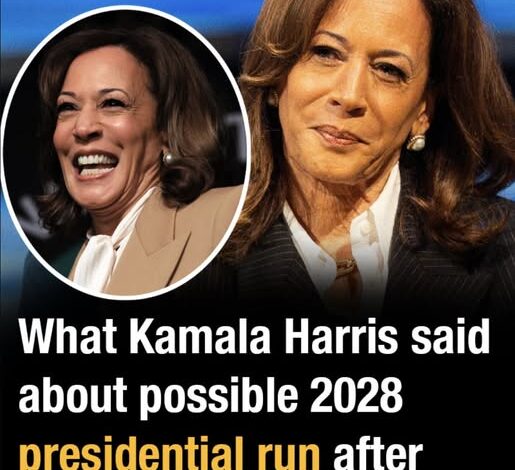
Kamala Harris’s measured acknowledgment that she is considering a 2028 presidential run feels less like speculation and more like the first deliberate step in a much longer, carefully calculated journey. It carries the tone of someone who has stood close enough to the presidency to understand both its gravity and its limitations—and who is no longer interested in pretending that the country’s challenges can be smoothed over with familiar talking points.
In her recent appearances, particularly across the South and other regions often overlooked in national narratives, Harris has leaned into a message shaped by what she’s hearing directly from people. There’s a growing sense, she suggests, that the systems many Americans were told to trust are no longer working as they should. Economic strain, political division, and institutional fatigue are not abstract ideas—they’re daily realities. By framing her message this way, she positions herself not just as a candidate, but as someone attempting to articulate a broader frustration that cuts across traditional lines.
At the same time, her comments on foreign policy—especially her pointed reference to what she describes as a “war of choice” involving Iran—offer a glimpse into how she may define herself on the global stage. The language is intentional. It signals a desire to project strength and decisiveness, while also drawing a clear boundary against actions she characterizes as unnecessary or destabilizing. In doing so, she appears to be crafting a contrast with Trump-era approaches, suggesting she would pursue a path that is firm but more restrained when it comes to the use of military force.
This balancing act—projecting toughness without appearing impulsive—may become central to her political identity moving forward. It speaks to a broader challenge she faces: convincing voters that she can lead with authority while also learning from the complexities and criticisms of the past. The shadow of the 2024 election still lingers, and whether the electorate is ready to reconsider her on a national scale remains uncertain.
There is also a strategic patience in how she is handling the moment. Rather than making a definitive declaration, Harris is allowing the possibility of a run to develop gradually. This approach keeps her in the conversation without forcing an immediate commitment, giving her time to gauge public sentiment, consolidate support, and refine her message. It also creates a sense of anticipation—an awareness that something larger may be taking shape, even if the full picture isn’t yet visible.
For now, her stance exists somewhere between intention and ambiguity. She is not declaring, but she is not dismissing the idea either. That space allows her to remain flexible while still signaling seriousness. It invites attention without overexposure, curiosity without certainty.
Ultimately, the question isn’t just whether Harris will run—it’s whether she can reshape how voters see her. Her recent tone suggests an effort to do exactly that: to move beyond past perceptions and present herself as a leader attuned to both domestic frustrations and global complexities.
Until a formal decision is made, the country is left in a kind of suspended moment—watching, listening, and interpreting each statement for clues. And Harris, for her part, seems content to let that moment linger, offering just enough to keep the conversation alive while holding back the final answer.