YOUR HIDDEN PERSONALITY REVEALED AS SCIENTIFIC COLOR TEST PROVES HOW DIFFICULT YOU REALLY ARE TO WORK WITH

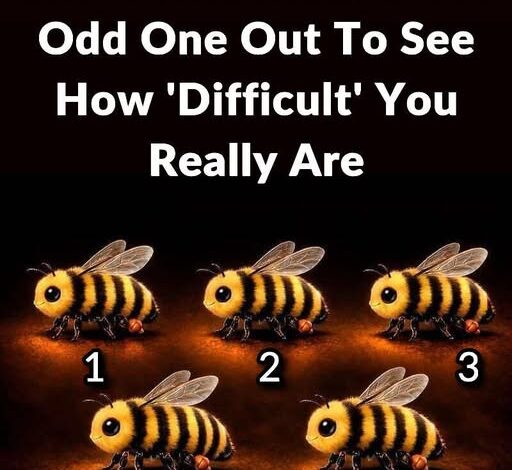
The human mind is not a simple lens that captures reality as it is—it is more like a filter, quietly shaping everything we see through layers of memory, emotion, and instinct. We often assume that what we notice is objective, that our perception is neutral. But in truth, every glance we take is influenced by who we are, what we’ve experienced, and how our brain is wired to prioritize certain details over others.
This idea becomes especially clear in simple visual exercises—the kind that ask you to pick what doesn’t belong. At first, they seem easy, almost trivial. But beneath that simplicity lies something deeper. When you’re faced with an image that doesn’t have a single obvious answer, your brain is forced to make a choice based on instinct. And that instinct reveals more about you than you might expect.
Imagine looking at an image filled with movement—like bees in motion against a soft, abstract background. Some people will immediately focus on the bees, drawn to their energy, their direction, their purpose. Others will barely notice them, instead becoming absorbed in the colors and patterns behind them. And then there are those who don’t fully settle on either, noticing the space between, the contrast, the relationship between elements rather than the elements themselves.
That first reaction—what you notice before you even think—isn’t random. It reflects how your mind organizes the world.
If you tend to lock onto the most obvious or active element first, you may have an instinct-driven mindset. You respond quickly, trust your gut, and prefer clarity over complexity. In fast-moving situations, this can be a strength—you act when others hesitate. But it can also mean you move past details that might matter later.
If your attention goes to small inconsistencies or subtle details, you may lean toward careful observation. You notice what others miss. You double-check, analyze, and look for patterns beneath the surface. This can make you incredibly precise, but it may also slow your decisions, especially when certainty feels just out of reach.
If you naturally try to take in the whole picture—the relationship between different parts—you may have a more balanced or integrative way of thinking. You’re likely drawn to understanding how things connect rather than choosing one perspective over another. This can make you thoughtful and fair, though sometimes it can lead to hesitation when a clear decision is needed.
If your mind drifts toward interpretation—seeing meaning, story, or symbolism rather than just structure—you may lean toward creative thinking. You don’t just see what’s there; you imagine what it could represent. This allows you to approach problems in unique ways, though others may not always follow your line of thought immediately.
And if your first instinct is to question the task itself—why it’s designed this way, what it reveals, what lies behind it—you may be more analytical at a deeper level. You look beyond the surface, not just at the image, but at the system behind it. This kind of thinking brings insight, but it can also lead to overthinking, where answers feel less important than the questions themselves.
What makes this kind of exercise so powerful is that it highlights something we often overlook: perception is personal. Two people can look at the exact same image and experience it completely differently. Neither is wrong—they’re simply seeing through different lenses.
This is why the idea of someone being “difficult” is often more about perspective than truth. A fast decision-maker may see a cautious thinker as slow. A detail-focused person may see a big-picture thinker as careless. A creative mind may feel misunderstood by someone who values structure.
In reality, these differences aren’t flaws—they’re variations in how the mind works.
Understanding your own tendencies is the first step toward recognizing that your way of seeing the world is just one version of many. It doesn’t make it better or worse—just different.
And once you see that, something shifts.
You stop assuming that others are wrong simply because they see differently. You start to notice the value in perspectives that don’t match your own. And you begin to understand that perception isn’t just about what’s in front of you—it’s about what you bring to it.
So the next time you’re faced with a simple visual choice, pause for a second.
What did you notice first?
Because that answer might tell you less about the image—and more about yourself.