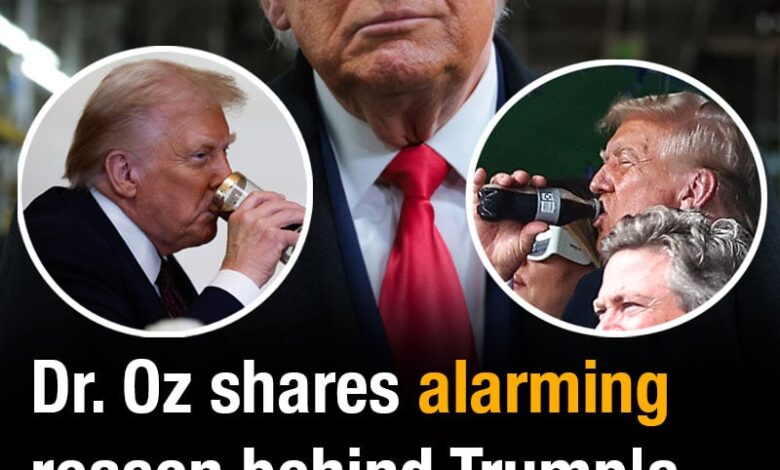
Dr. Mehmet Oz’s account from Air Force One offers a moment that feels almost surreal in its intimacy: a former president, powerful and publicly larger-than-life, holding an orange Fanta and joking—half-serious, half-playful—that it might “kill cancer cells” because it can kill grass. On the surface, it sounds absurd, even humorous. But beneath that odd logic sits something far more revealing: a glimpse into how personal beliefs about health can take root and persist, regardless of status, influence, or access to expert advice.
What makes the moment striking isn’t just the claim itself, but what it represents. Trump’s well-known preference for diet soda, often treated as a quirky footnote in his public image, begins to look different in this light. It becomes less about taste or habit and more about a narrative he may have constructed for himself—one that frames his choices as protective, even beneficial, rather than merely indulgent.
There’s a deeply human element here. Strip away the power, the politics, the spectacle, and what remains is a familiar scene: an older man trying to make sense of his health, leaning on reasoning that feels convincing to him, even if it doesn’t hold up to scientific scrutiny. The comment, paired with his son’s praise of his “energy, recall, stamina,” suggests a quiet undercurrent of concern—an awareness of aging, countered by confidence in his own explanations for staying well.
Science, of course, offers a far clearer picture. Diet soda does not kill cancer cells, and its health benefits are minimal at best. But moments like this highlight a broader truth: facts alone don’t always shape behavior. People often rely on beliefs that feel intuitive, comforting, or personally validated, especially when it comes to something as complex and uncertain as health.
In that sense, the exchange is less about one individual and more about a universal tendency. Whether in everyday life or at the highest levels of power, people hold onto ideas that help them feel in control. Even when evidence points elsewhere, those beliefs can become part of how they justify choices, manage fears, and maintain a sense of certainty.
What seems comical at first glance ultimately reveals something more profound: the gap between knowledge and belief isn’t just a public issue—it’s a deeply personal one.