I walked into the interview carrying more than just a résumé—I carried the quiet weight of a mistake I couldn’t stop replaying. Losing that bookstore job had settled into me like proof of failure, and the only thing I’d held onto was the brooch. It felt like a small, fragile reminder that something good had existed in the middle of everything I’d messed up.
When the hiring manager’s eyes paused on it, I braced myself. I imagined her seeing it as too much, too strange, another sign that I didn’t quite belong. But her expression didn’t match my fear. It shifted—first surprise, then something softer, almost unsettled. She didn’t say much, just asked me, gently but firmly, to come with her.
The moment we stepped into the owner’s office, the atmosphere changed. It wasn’t just another part of the building—it felt heavier, quieter, as if something unspoken lived there. When his eyes found the brooch, everything stopped. The reaction was immediate and unmistakable. His face lost its color, and for a second, it seemed like he might not even be seeing me—only what I was wearing. His hand lifted slowly, unsteady, like he wasn’t sure he was allowed to reach for it. Then he said a name, barely above a whisper, as if speaking it too loudly might break whatever fragile thread had just been found.
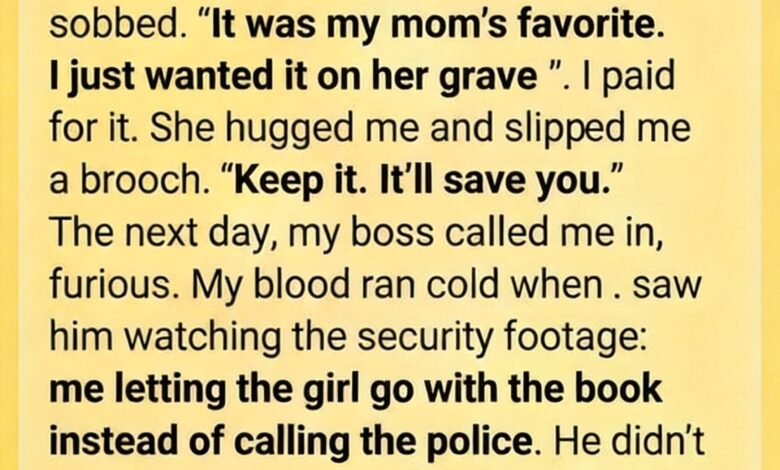
As I told the story—about the girl, the book, the moment that had cost me everything—I could see it landing in him piece by piece. There was recognition there, but also disbelief, like hope and grief were colliding in real time. It wasn’t a clean emotion. It was raw, complicated, and overwhelming to witness. The room seemed to hold its breath as he listened, as if the past was quietly rearranging itself in front of us.
Somewhere in that exchange, what I had believed was my worst mistake began to take on a different shape. The thing I had carried as proof of failure was, somehow, the missing link in someone else’s story—a connection he had lost and never expected to find again. It didn’t feel triumphant. It felt humbling, almost disorienting, to realize that something I regretted so deeply could mean so much to someone else.
I had walked into that building convinced I was trying to fix a broken future, still defined by what I’d done wrong. I walked out with more than just a second chance at work. I left with a sense that purpose doesn’t always arrive neatly or predictably. Sometimes it comes disguised as a mistake, something you’d undo in a heartbeat if you could—until you see where it leads.
And that stayed with me: the quiet, unsettling truth that not every broken rule is just a failure. Sometimes, without meaning to, it becomes the exact moment that changes everything—for someone else, and for you.