The Unholy War Between The White House And The Vatican Why JD Vances Shocking Accusation Against Pope Leo Has The Entire World Bracing For A Spiritual Collapse

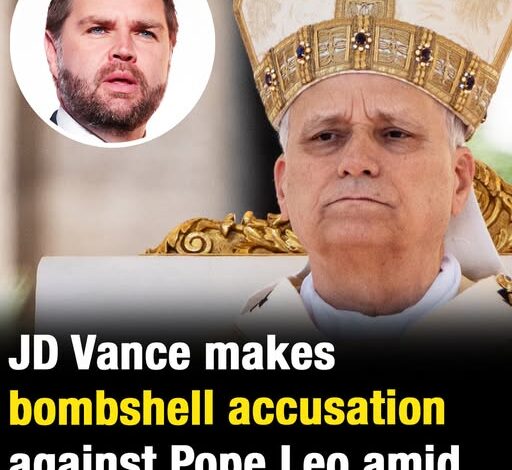
The corridors of political power in Washington and the spiritual authority of the Vatican have, at various moments in history, found themselves at odds. But rarely has that tension felt so immediate, so public, and so sharply defined. What began as pointed criticism has evolved into something more symbolic—a broader clash over influence, responsibility, and the role moral authority should play in shaping national decisions.
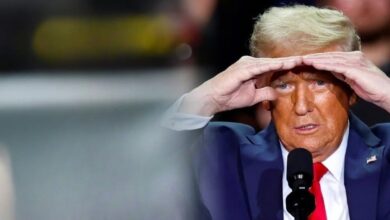
At the center of this moment is a highly visible disagreement involving Donald Trump, Pope Leo XIV, and a controversial intervention from JD Vance. The dispute has moved beyond policy differences and into a deeper, more philosophical space: who ultimately has the right—or the obligation—to guide the direction of a nation when the stakes involve both power and principle?
The friction intensified after Trump issued sharp criticisms of the Pope, questioning his stance on global conflicts and portraying his calls for restraint as impractical in a world shaped by hard geopolitical realities. The Pope, consistent with the Church’s long-standing emphasis on peace and human dignity, continued to advocate against escalation, particularly in regions already burdened by instability. What one side framed as moral clarity, the other interpreted as overreach into matters reserved for sovereign governments.
The situation grew more charged with the circulation of provocative imagery and rhetoric that blurred the line between political messaging and religious symbolism. While some supporters dismissed such gestures as exaggerated or symbolic, critics saw them as crossing into territory that risks conflating secular authority with sacred imagery—an area historically fraught with tension.
JD Vance’s comments added another layer to the conflict. As a public figure with ties to both political and religious spheres, his remarks carried particular weight. By suggesting that the Vatican should limit its role to general moral guidance and refrain from engaging in specific policy debates, he articulated a perspective rooted in a strict separation between governance and spiritual counsel. It was, in effect, a modern restatement of an old argument: that elected leaders, accountable to their citizens, must retain full authority over decisions involving national security and global strategy.
From this viewpoint, the complexities of modern governance—military planning, diplomatic negotiations, economic stability—require expertise, accountability, and access to information that religious institutions do not possess. Supporters of this stance argue that while moral considerations are important, they cannot override the immediate responsibilities of those tasked with protecting a nation’s interests.
Yet the opposing perspective is equally deeply rooted in history. For the Catholic Church, and for many who support its role, the Pope’s voice is not meant to be confined to abstract principles. It is intended to serve as a moral counterbalance—an external conscience that challenges political leaders when decisions risk prioritizing power over humanity. From this angle, silence in the face of potential conflict is not neutrality, but failure. The Church’s intervention, therefore, is not an intrusion but a duty.
The public response to this clash reflects the broader divisions within contemporary society. Some view the administration’s posture as a necessary assertion of independence and strength, a refusal to allow unelected institutions to shape national policy. Others see it as a troubling dismissal of ethical accountability and a sign that political leadership is drifting further from universally shared moral frameworks.
What makes this moment particularly striking is not simply the disagreement itself, but its visibility and tone. Historically, tensions between political leaders and religious authorities have often been handled with a degree of diplomatic restraint. Here, the directness of the exchange—and the speed with which it has spread across modern media channels—has amplified its impact, turning it into a global conversation about the boundaries of influence.
At its core, the conflict raises a question that has persisted for centuries: can decisions about power ever be fully separated from questions of morality? Political leaders operate within the constraints of national interest and immediate consequence, while religious voices often speak to longer-term ethical considerations that transcend borders. When these perspectives collide, the tension is not easily resolved—it reflects two fundamentally different ways of understanding responsibility.
As this standoff continues to unfold, it serves as a reflection of a broader shift in how authority is perceived in the modern world. The traditional alignment between moral guidance and political power has become more fractured, replaced by a landscape where influence is contested openly and often aggressively. Whether this leads to a clearer separation between these spheres or a renewed effort to reconcile them remains uncertain.
For now, the significance of this moment lies not just in the individuals involved, but in what it reveals about the evolving relationship between faith, governance, and public trust. It is a reminder that in times of uncertainty, the struggle to define who gets to shape the future—through policy, through principle, or through persuasion—becomes as consequential as the decisions themselves.