I Raised My Sister’s 9 Children After She Vanished During a Storm – 12 Years Later, My Youngest Nephew Looked at Me and Said, ‘I Know Where Mom Is Now’

For twelve years, I kept a promise I made on the worst night of my life.
I told my missing sister’s children they would never be abandoned.
And I meant it.
I raised them. Fed them. Fought for them in schools, in hospitals, in quiet moments when grief hit without warning. I became the one who stayed.
So when her youngest son came home one afternoon, looked me straight in the eye, and said, “I’m ready to tell you the truth,”—I knew everything was about to change.
The night Alice disappeared, the storm came in hard and sudden. The kind that rattles windows and makes the world feel unstable.
She had asked me to watch the kids while she went into town.
She never came back.
Her car was found off the road, crushed under a fallen tree.
Everyone said it was an accident.
I knew better.
But I had no proof—only instinct, and nine children who needed me more than theories.
So I stayed.
Years passed.
The casseroles stopped. The calls slowed. The town moved on.
But the house didn’t.
The children grew up inside it, carrying questions that never quite found answers.
Daniel, the youngest, had been four when she vanished.
Now he was sixteen.
And something in him had changed.
He had been distant for weeks—quiet, restless, shutting himself away.
One afternoon, I stopped him in the hallway.
“No more avoiding me,” I said. “Tell me what’s going on.”
He went pale.
Then he reached into his backpack and pulled out a rusted tin box.
“I found this,” he said. “Under the attic floor.”
Inside was a necklace I had given Alice years ago.
A photograph.
And a bundle of letters tied with a faded blue ribbon.
The first note made my chest tighten.
If you are reading this, something happened. I couldn’t come back like I promised. I hid this because I was already afraid. Someone is watching me. If you’re old enough to understand, go to Blackwood Chapel. If I’m not there, wait until nightfall.
The second note was shorter.
More chilling.
Do not trust everyone who mourned me.
Daniel’s voice shook. “I read one of them. Then I stopped.”
“Why?” I asked.
“Because someone’s been messaging me.”
Anonymous messages.
No name. No picture.
Just words.
Some graves should stay closed.
Dead women should stay dead.
That night, we went to the chapel.
Blackwood Chapel had been abandoned for years. Rotting wood. Broken windows. The kind of place people avoided without needing a reason.
Behind the altar, we found a narrow door.
And below it—a staircase.
The air underground was cold and stale.
My flashlight swept across the room—
—and landed on a coat.
Alice’s coat.
Then a voice came from the shadows.
“I knew one day you would come.”
I turned.
And there she was.
Older. Thinner. Pale.
But alive.
Daniel made a sound I had never heard before and ran to her.
She dropped to her knees and held him like she was afraid he might disappear again.
I stood frozen.
Because this wasn’t relief.
Not yet.
This was something far more complicated.
“I wanted to come back,” she said, her voice breaking.
“Then why didn’t you?” I asked.
The answer came slowly.
And it changed everything.
Years ago, before he died, her husband had uncovered something.
Money disappearing from a church charity.
Adoption records being altered.
Children being moved—quietly, quickly—when certain names signed off.
He had started keeping records.
And then he died.
After that, the warnings began.
Notes.
Calls with no voices.
Cars that didn’t belong.
People who knew too much.
The day Alice disappeared, she wasn’t just running errands.
She was meeting someone who claimed to have proof.
She never made it.
A car forced her off the road.
She escaped the crash.
But someone found her in the woods.
“Who?” I asked.
Her answer didn’t make sense.
Not at first.
“Tom.”
Sheriff Tom.
The man who led the search.
The man who sat in my kitchen.
The man who told the children, “We’re not giving up.”
He had told her if she came back, the children would suffer.
And then he proved it.
With photos.
Of them.
So she stayed away.
For twelve years.
Moving constantly. Living under different names. Waiting for a moment that never came.
Until now.
Because Tom was about to retire.
Because she had finally found the rest of the evidence.
Because she couldn’t let him walk away untouched.
The proof was hidden.
In a lockbox.
Under the root cellar of our old house.
Daniel wanted to go that night.
I didn’t.
Instead—
I made a mistake.
I went to Tom.
He stood on his porch, smiling.
Calm. Friendly. Familiar.
But when I mentioned the chapel—
his face flickered.
Just for a second.
That was enough.
That night, we dug.
The house was gone, but the foundation remained.
The cellar door creaked open like something that hadn’t been disturbed in years.
We climbed down.
Started digging.
Then a voice stopped us.
“You should have left this buried.”
Tom stood above us.
Gun in hand.
Everything became still.
“What did he find?” I asked.
Tom sighed.
“Enough to be inconvenient.”
He didn’t deny it.
He didn’t need to.
Children had been moved for money.
Records altered.
Lives redirected.
And anyone who got too close—
was silenced.
“You took years from my children,” Alice said.
Tom shook his head.
“No. You gave them up.”
Then—
tires on gravel.
He heard it.
So did we.
Daniel moved first.
“I’m recording,” he whispered.
Everything happened at once.
I grabbed Tom’s wrist.
The gun fired—splintering wood.
Daniel struck his leg.
Alice swung the shovel.
The floor gave way beneath him.
He fell.
Hard.
By the time state police arrived, Tom was trapped under broken beams.
Still shouting.
Still trying to control something that had already ended.
The recording was enough.
The lockbox was everything.
Ledgers.
Names.
Dates.
Proof of everything my brother-in-law had died trying to expose.
Two days later, Alice came home.
Not like a miracle.
Like something unfinished returning to where it began.
The children reacted in their own ways.
Some ran to her.
Some hesitated.
Some didn’t know what to feel at all.
“Did you still love us?” one of them asked.
“Every day,” she said.
Daniel stayed close to her.
As if distance might take her again.
And me?
I didn’t know where I stood.
For twelve years, I had been the one who stayed.
The one who carried everything.
That night, when the house finally quieted, I asked her:
“I don’t know what I am now.”
She looked at me for a long time.
Then she said softly—
“The reason they made it.”
That broke something open in me.
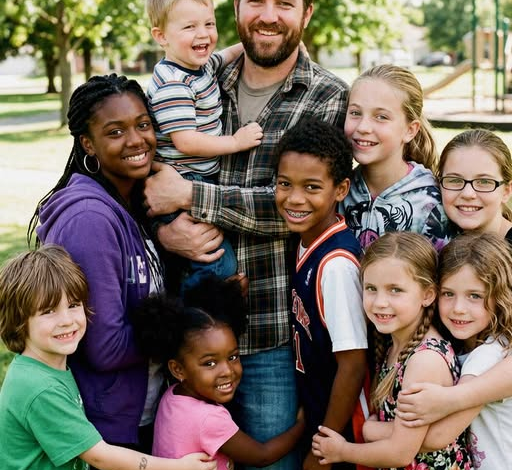
Later, all eleven of us sat at the table.
Loud. Messy. Real.
The way families are when they don’t know how to be anything else.
Daniel looked around and said, “I thought the truth would destroy us.”
No one argued.
I looked at Alice.
At the children.
At everything we had carried.
And I said quietly:
“The lies already were.”
No one argued.
Rachel just passed the bread.
And this time—
Alice was there to take it.