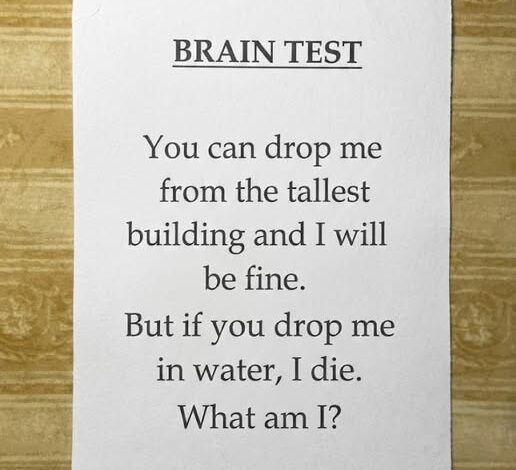
The riddle’s brilliance lies not in how complicated it is, but in how precisely it steers your thinking without you noticing. From the very first line, it sets a trap—one that feels logical, almost inevitable. It presents itself like a problem about force, impact, and survival. Something falls from a great height. Instantly, your mind begins sorting through possibilities: what could endure that kind of drop? You start listing materials—metal, stone, rubber, something engineered, something tough. You stay within the boundaries the riddle quietly built for you.
And that’s the point.
Because while you’re focused on strength, the riddle is really about vulnerability.
The phrase “die in water” is the hinge. It doesn’t quite belong in the world you’ve been thinking in. Objects don’t “die.” They break, shatter, crack, or sink—but they don’t die. That single word introduces a different category altogether, one that most people initially overlook. It suggests something that depends on conditions, something that exists only while certain elements are in balance.
But by the time you notice that, you’re already deep in the wrong framework.
That’s why the realization feels so sharp when it comes. The answer—fire—doesn’t just solve the riddle; it exposes the path you took to get there. Fire doesn’t survive a fall because it’s strong. It survives because it isn’t governed by the same rules as solid objects. It can be carried, dropped, or scattered, and still persist as long as it has air and fuel. Height is irrelevant to it. Gravity doesn’t destroy it.
Water, however, does.
Instantly. Completely.
And suddenly the riddle makes perfect sense—not because it became harder, but because it became clearer. You weren’t missing knowledge. You were following the wrong assumptions.
That’s what gives the riddle its lasting power. It doesn’t test intelligence in the traditional sense; it tests flexibility. It reveals how quickly the mind locks onto a pattern and resists leaving it, even when subtle clues point elsewhere. The more confident you are in your initial interpretation, the harder it becomes to step outside of it.
There’s also something deeper happening beneath the surface. Riddles like this play on language itself—on how certain words carry expectations. “Fall,” “survive,” “die”—each one nudges you toward a familiar context. Together, they construct a scenario that feels grounded in the physical world. But the solution exists just outside that frame, waiting for you to shift your perspective rather than push further within it.
That’s why the answer often feels obvious in hindsight. Not because it was easy, but because it was always visible—you just weren’t looking in the right way.
In a broader sense, that’s what makes riddles endure across generations. They mirror the way we think in everyday life. We build assumptions quickly, rely on patterns, and often mistake familiarity for accuracy. The challenge isn’t always finding new information—it’s recognizing when our current way of thinking is limiting what we can see.
So the real satisfaction doesn’t come from saying “fire.” It comes from that brief moment of awareness, when you realize the riddle didn’t outsmart you—you outsmarted yourself. And in that realization, there’s a quiet reminder: sometimes the answer isn’t hidden.
It’s just waiting on the other side of a question you didn’t think to ask.