Erika Kirk Breaks Her Silence After Canceling a High-Profile Appearance With Vice President JD Vance Due to “Very Serious Threats,” Raising Questions About Political Safety, Public Events, Personal Risk, and the Growing Tension Surrounding High-Visibility Figures in Today’s Intensely Divided Climate

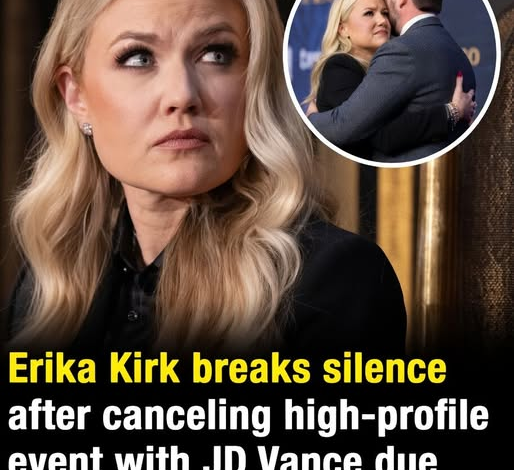
The sudden cancellation of a planned public appearance by Erika Kirk alongside JD Vance has drawn significant attention—not only because of the figures involved, but because of what the situation reflects about the current climate for public engagement. The event, scheduled at the University of Georgia, was expected to attract a large audience and continue a series of joint appearances between the two. Instead, just hours before it was set to begin, Kirk withdrew, citing “very serious threats” directed toward her.
That decision immediately shifted the focus from the event itself to a broader and more concerning issue: safety.
Cancellations are not unusual in public life, but the reason behind this one carries particular weight. It highlights the increasing challenges faced by public figures whose visibility can expose them to heightened risks. In an era where information spreads instantly and public attention is constant, even routine appearances now require careful security considerations.
Understanding the context of Erika Kirk’s role adds another layer to the situation. Over the past year, she has stepped into a highly visible leadership position following the death of her husband, Charlie Kirk. As CEO of Turning Point USA, she has taken on a prominent role in political and activist spaces, appearing regularly at events and on university campuses. Her presence often represents both continuity for the organization and her own willingness to engage publicly despite personal loss.
That background makes her decision to cancel particularly notable. It suggests that the threats were taken seriously enough to outweigh not only the importance of the event, but also her demonstrated commitment to public engagement.
The appearance with JD Vance was part of an ongoing pattern of collaboration between two figures who share overlapping audiences. Their previous events had drawn attention for both their messaging and their on-stage dynamic, making the Georgia appearance a continuation of an established presence. Its cancellation, therefore, was not just a logistical change—it disrupted a broader trajectory of public interaction.
According to statements from those involved, the decision was driven by credible concern. Reports indicated that the threats prompted discussions about whether the event itself should proceed at all. JD Vance acknowledged that safety considerations were central to those conversations, underscoring how quickly circumstances can shift when risk levels change.
When Kirk addressed the situation publicly, her response reflected both disappointment and clarity. She emphasized that she had intended to participate and that the decision was not made lightly. At the same time, she pointed to the importance of listening to security professionals and taking precautions seriously. Her message balanced personal resolve with an acknowledgment of the realities involved.
The broader implications extend beyond a single canceled event. In recent years, concerns about the safety of public figures—particularly in political and activist spaces—have become more pronounced. Appearances that once required standard planning now involve heightened awareness of potential threats. This shift affects not only speakers, but also institutions hosting events and audiences attending them.
It also raises questions about the long-term impact on public discourse. When participation in open forums becomes more complicated or risky, it can influence who chooses to engage—and how often. The result is a more constrained environment, where the ability to speak publicly is shaped not only by willingness, but by security considerations.
Reactions to the cancellation have varied, reflecting the broader divisions within public life. Supporters have emphasized the importance of prioritizing safety, while others have questioned the circumstances or implications. This range of responses highlights how even issues of personal security can become part of larger debates.
Ultimately, the situation underscores a simple but important reality: visibility carries both opportunity and risk. For Erika Kirk, stepping back from the event appears to have been a decision grounded in caution and responsibility. For observers, it serves as a reminder of the evolving conditions under which public figures operate.
As these dynamics continue to unfold, the balance between open engagement and personal safety is likely to remain a central challenge—one that shapes not just individual events, but the broader landscape of public conversation.