The Mesmerizing Eyeball Eggs: Nature’s Bizarre Translucent Jelly Clusters with Staring Black Pupils That Captivate the World in a Surreal Biological Spectacle These captivating translucent spheres cradled in a human palm look like something straight out of a sci-fi movie or a surreal candy shop, but they are actually a remarkable biological wonder known as amphibian egg masses

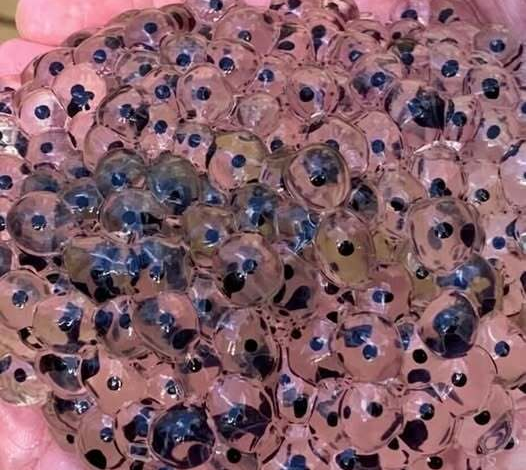
At first glance, these shimmering, translucent spheres resting in a human hand look almost unreal—like something from a science fiction film or an unusual confection. In reality, they are a fascinating natural phenomenon: amphibian egg masses. The image shows a tightly packed cluster of jelly-like orbs, each one perfectly round and nearly transparent, with a dark center that eerily resembles a tiny eye staring outward. This striking appearance has earned them the nickname “eyeball eggs” online, where nature lovers and photographers often share images of them with both admiration and a hint of unease.
Most commonly, clusters like this belong to species such as the Southern leopard frog (Lithobates sphenocephalus), though similar egg masses can be found among other pond-breeding amphibians. The soft pink tint visible in the cluster is usually the result of lighting conditions or reflections from the surrounding environment, rather than a defining biological trait. Each orb is its own protective capsule, sheltering a developing embryo inside. Together, they form a dense mass that highlights nature’s efficient way of protecting fragile life in unpredictable wetland environments.
The structure of these eggs is remarkably sophisticated. Each one is surrounded by a gelatinous coating composed largely of water, specialized proteins, and complex sugars. This layer acts as a multifunctional shield—it helps prevent the eggs from drying out, filters harmful sunlight, and offers some resistance to bacteria and fungi. Its slippery texture can also discourage predators. When clustered together, the eggs benefit from strength in numbers; while some may be lost, many survive simply due to the volume of the group.
The dark “pupil” seen in each egg is the embryo itself. Early in development, it appears heavily pigmented, which can help with camouflage when viewed from above or below. As the embryos grow, their structure becomes more defined, eventually forming recognizable features like the beginnings of a tail and head. The jelly surrounding them also swells as it absorbs water, giving the cluster its soft, bouncy appearance.
These egg masses are typically found in shallow, seasonal water bodies such as ponds, wetlands, or vernal pools. Many amphibians choose these locations because they are often free of fish that might otherwise prey on the eggs. During breeding season—usually in early spring—males call out to attract females. Once paired, the female releases hundreds or even thousands of eggs, which the male fertilizes externally. The result is the kind of clustered mass seen here, often attached to vegetation or floating freely in the water.
Inside each egg, a complex transformation is underway. After fertilization, the embryo begins dividing and organizing into basic structures. Over time, it develops into a tadpole, complete with gills and a tail, ready for life in the water. Oxygen passes through the jelly coating, allowing the embryo to breathe, while waste products diffuse outward. When conditions are right, the tadpoles hatch and begin their aquatic life, eventually undergoing metamorphosis into frogs.
Beyond their biological role, these egg clusters are also important indicators of environmental health. Amphibians are highly sensitive to changes in their surroundings, so thriving egg masses often suggest clean water and stable habitats. Conversely, their absence can signal ecological problems such as pollution or habitat loss.
Images like this one often capture attention online, not just because of their unusual appearance, but because they reveal how much wonder exists in ordinary places. What might seem strange or even unsettling at first becomes something extraordinary when understood.
In the end, these “eyeball eggs” are more than just a visual curiosity—they are a reminder of nature’s complexity and resilience. Each tiny sphere holds the beginning of a life, part of a cycle that has continued for millions of years. The next time you come across a cluster like this, take a moment to appreciate the quiet miracle unfolding inside.