HIGH SEAS SHOWDOWN US Army Intercepts Mysterious Vessel In Sensitive Waters Triggering Global Security Alert

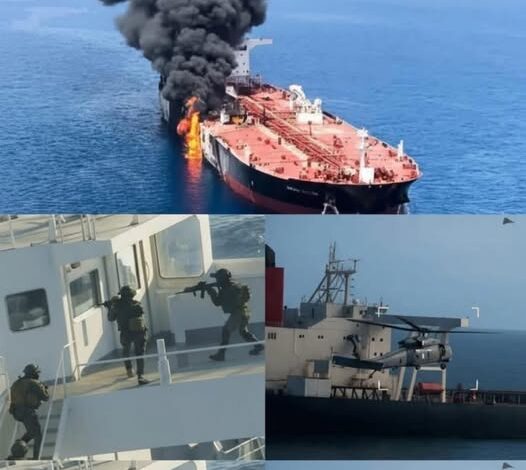
The world’s oceans—vast, vital, and often volatile—have once again become the backdrop for a tense security operation, as U.S. military forces intercepted and secured a vessel under suspicious circumstances. The incident, which occurred in a strategically important maritime region, has drawn attention from defense analysts and policymakers alike, underscoring how fragile stability can be across global waterways.
According to defense officials, the operation was executed with speed and precision, the result of careful intelligence work rather than chance. While the exact location has not been publicly disclosed, the area is known to be a key route for international shipping and military transit. U.S. forces tracked the vessel, signaled it to stop, and ultimately boarded it—an action that immediately sparked curiosity and concern about what might be discovered onboard.
In the hours following the interception, speculation spread rapidly online. Some theories pointed to illegal weapons transport, while others suggested espionage or sanctions evasion. Despite the noise, official statements have remained cautious. U.S. authorities emphasized that the interception was part of ongoing efforts to safeguard international shipping lanes and maintain regional stability, rather than a response to a confirmed imminent threat.
Still, the scale and coordination of the operation suggest it was far from routine. In today’s security environment, monitoring vessels that operate without identification systems—or deliberately obscure their movements—has become increasingly important. These so-called “ghost ships” are often associated with illicit trade or covert missions. Successfully stopping such a vessel highlights the reach and capability of modern surveillance and naval enforcement.
As the investigation unfolds, officials are urging patience. Examining the ship’s cargo, verifying documentation, and questioning the crew all take time. There is also a diplomatic dimension to consider, especially in regions where territorial claims overlap or military presence is sensitive. Premature conclusions could complicate ongoing discussions behind closed doors.
The broader significance of this event lies in what it represents. Global trade depends heavily on secure sea routes, and even minor disruptions can ripple through economies. At the same time, the oceans have become a stage for subtle forms of conflict—operations that avoid open warfare but still test boundaries. Interceptions like this serve as a reminder that maintaining order at sea requires constant vigilance.
There’s also a human side to the story. Crews on such vessels are not always fully aware of what they are transporting or who ultimately controls the mission. Untangling ownership structures—often hidden behind layers of shell companies—can be just as challenging as identifying the cargo itself. For investigators, the real objective is tracing the operation back to its source.
For now, the vessel remains under U.S. control as experts work to uncover its purpose. Whatever the final findings may be, the interception itself sends a clear signal: the open ocean may be vast, but it is not beyond oversight. In a world where uncertainty increasingly travels by sea, moments like this highlight the ongoing effort to keep global waters secure, stable, and governed by more than just distance and depth.