THE SECRET BEHIND THE DOVES REVEALED HOW THIS MYSTERIOUS VISUAL TEST EXPOSES THE HIDDEN GUARDIAN WALKING BY YOUR SIDE AND THE TRUTH ABOUT YOUR FUTURE

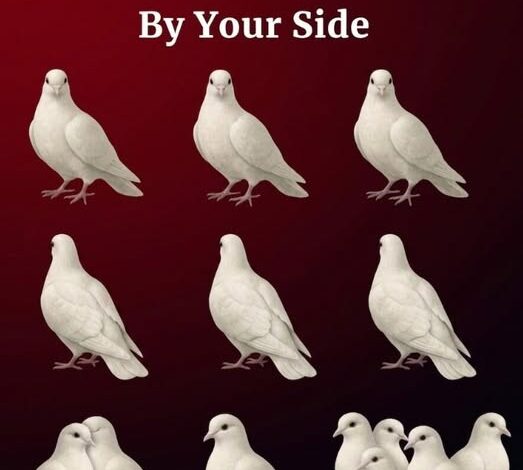
Human perception is rarely just passive observation—it’s an active process shaped by interpretation, memory, and emotion. This idea sits at the heart of a viral visual puzzle that has sparked widespread curiosity and debate. At first glance, the image seems simple: a neat arrangement of identical white doves resting against a მშვიდ, uncluttered background. It appears orderly, almost calming. But the longer you look, the more that simplicity begins to unravel, turning the image into something far more personal and revealing.
Initially, the brain tries to make sense of the scene through structure. It looks for symmetry, counts shapes, and organizes the birds into a predictable pattern. This is how we naturally process the world—by imposing order. Yet after a few moments, something shifts. Your attention begins to wander across the image, noticing subtle differences: spacing, clusters, and empty areas. Without realizing it, you start grouping the doves in your own unique way. What was once just a picture becomes a canvas for your mind to interpret.
The dove itself plays an important role in this transformation. Across cultures and history, it has symbolized peace, purity, hope, and sometimes spiritual presence. Because of these associations, your brain doesn’t just see birds—it assigns meaning instantly. A lone dove might feel symbolic of independence or solitude. A pair may suggest connection or partnership. These interpretations happen almost automatically, shaped by shared cultural ideas and personal experiences.
As you begin to notice larger groupings, the meanings can shift again. Groups of three might feel balanced or complete, while bigger clusters can suggest community, support, or even overwhelm. The way you interpret these groupings often reflects your current mindset. Someone feeling secure may see unity and harmony, while someone under stress might perceive crowding or pressure. The image doesn’t change—your perspective does.
What draws your eye first can also feel significant. If you focus on a bird at the edge, you might identify with observation or independence. If your attention goes straight to the center, it may reflect a tendency to engage directly with life’s main events. These interpretations aren’t fixed truths, but they reveal how attention and focus can mirror personality and emotional state.
This is why the “dove test” has resonated with so many people. It creates the illusion of a shared experience while quietly producing deeply personal responses. Two people can look at the same image and walk away with entirely different impressions—one feeling calm and reassured, the other sensing urgency or change. It highlights an important truth: we don’t just see the world as it is—we see it as we are.
Beyond its symbolic appeal, the puzzle also offers insight into how the brain handles ambiguity. It shows how we group information, prioritize details, and fill in gaps when meaning isn’t obvious. Like other visual challenges, it’s less about finding a “correct” answer and more about understanding how we think.
In the end, the image of the doves doesn’t hold a hidden message on its own. The meaning comes from the viewer. It reflects our tendency to search for patterns, assign significance, and connect visuals to emotion. Whether you interpret it as something spiritual or simply psychological, it creates a moment of pause—a chance to look inward.
The doves remain unchanged, quietly arranged as they were from the beginning. But what you see in them—and what you feel—says far more about you than it ever could about the image itself.