Our Neighbor Had Our Cars Towed Without Warning, But When She Tried to Humiliate Us in Front of the Whole Street, She Never Expected the Truth to Come Out—or How the Consequences Would Flip Her World Upside Down in a Single Afternoon

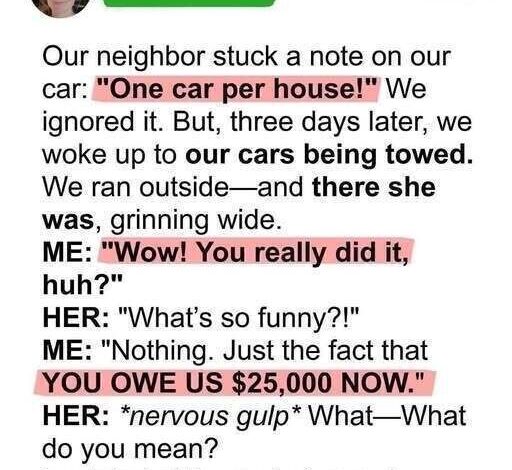
Jack and I had only just begun settling into the small rental house we’d secured for a six-month work assignment when things veered in a direction we never anticipated. On the surface, the neighborhood seemed almost too perfect—rows of identical houses, manicured lawns trimmed to the same height, and an atmosphere of carefully maintained calm. It was the kind of place that looked peaceful not because it naturally was, but because someone made sure it stayed that way.
We arrived late the evening before, drained from hours on the road and more interested in sleep than organization. Most of our boxes ended up stacked haphazardly in the living room, and the house looked like a temporary stop rather than a home. That was fine with us. We planned to unpack slowly, when work allowed. That next morning, with nowhere urgent to be and coffee in hand, we were enjoying the rare luxury of silence when a sudden, sharp knock shattered the calm.
Jack and I exchanged looks. We weren’t expecting anyone.
I opened the door to find a woman standing stiffly on the welcome mat, wearing a smile so wide and rehearsed it felt artificial. She held a tray of cookies, arranged with unsettling symmetry, each one identical—as if measured, shaped, and placed according to some unspoken rule. She introduced herself as Lindsey, our neighbor from down the street, her voice bright and overly cheerful.
At first glance, the gesture seemed kind. But the longer she stood there, the clearer it became that her interest wasn’t in welcoming us. Her eyes darted past me repeatedly, scanning the inside of the house with open curiosity—lingering on the stacked boxes, the shoes by the door, the half-built furniture, even the pet carrier near the wall. It felt less like a visit and more like an inspection.
Jack stepped closer behind me, sensing the same unease. Lindsey launched into conversation, asking questions that were technically polite but oddly intrusive: how long we planned to stay, where we worked, when exactly we’d moved in. Her tone remained sweet, but something beneath it felt sharp, calculating. Then, without any transition, her demeanor changed.
She straightened, tightened her grip on the tray, and said firmly, “Just so you know, the HOA has very strict rules. Only one vehicle per driveway.”
I blinked, caught off guard. “Only one?” I asked. “Our driveway fits both cars easily.”
Her smile returned, but it was colder now—professional, rigid. “Rules are rules,” she replied. “They don’t make exceptions.”
There was no warmth left in her voice. No welcome. Just authority she clearly enjoyed exercising. Before we could respond, she pressed the tray into my hands, pivoted sharply, and walked away, calling back, “Enjoy the cookies!”
The door closed behind her, leaving a heavy silence. Jack let out a breath. “We just met the neighborhood enforcer,” he muttered.
We never touched the cookies.
Despite how unsettling the interaction felt, we decided not to push back. We were temporary residents. Causing friction so early didn’t seem worth it. We parked as we had been and moved on with our days.
Three mornings later, just before sunrise, we were jolted awake by a deep, unfamiliar rumble. Engines. Multiple. Loud enough to vibrate the windows. Jack bolted upright, and we rushed to the front window.
Two tow trucks were parked directly in front of our driveway.
My stomach dropped.
Workers were already attaching chains to our cars, moving with practiced efficiency. There had been no warning. No notice. No chance to correct anything. Panic and disbelief hit at the same time. We threw on coats and rushed outside, the cold air biting as diesel fumes filled the street.
And there she was.
Lindsey stood at the edge of her lawn in a soft-colored bathrobe, both hands wrapped around a mug, watching the scene with unmistakable satisfaction. She didn’t need to say anything. Her expression said enough. She had called this in—and she wanted to witness the result.
When the tow operators noticed us, one asked, “These your vehicles?”
Jack nodded. Then, calmly, he said, “They’re government vehicles.”
Everything stopped.
One of the workers leaned closer, shining a flashlight at the windshield. He spotted the discreet sticker almost immediately. His posture changed. “These are exempt,” he said flatly. “We can’t tow these.”
Lindsey stepped forward, confusion overtaking her confidence. “What do you mean exempt?” she demanded.
The operator didn’t hesitate. “Federal exemption. HOA rules don’t apply.”
The silence that followed was thick. Chains were removed. Equipment packed up. The trucks left without another word.
Lindsey stood frozen, her earlier smugness completely gone. Her face drained of color as the reality of what she’d done settled in. She muttered something about a misunderstanding before retreating into her house, shutting the door quickly—as if closing it could erase the moment.
From that day on, things changed.
Neighbors we hadn’t seen before started acknowledging us—small waves, polite nods, brief smiles. Lindsey, meanwhile, stayed inside. Her curtains shifted now and then, but she never approached us again.
What she thought would be a demonstration of power had backfired spectacularly. Her attempt to control the situation exposed something deeper: her authority wasn’t real—it was assumed, enforced through intimidation and surveillance rather than actual understanding.
For Jack and me, the whole episode became one of those stories that only grows better with retelling. What began as a cookie-bearing welcome turned into a lesson in suburban politics, misplaced confidence, and poetic irony. In trying to assert control, Lindsey only embarrassed herself—and revealed how fragile her imagined power really was.
Sometimes the strangest conflicts don’t come from work or big cities or dramatic events. Sometimes they arrive at your door with a smile, a tray of perfectly arranged cookies, and a set of rules someone is far too eager to enforce.