Major Change to United States Military Draft Registration Rules Could Automatically Enroll Millions of Young Men Without Action, Sparking Debate Over Government Control, National Security Preparedness, and Whether Rising Global Tensions Signal a Shift Toward Reviving Conscription for the First Time Since the Vietnam War Era

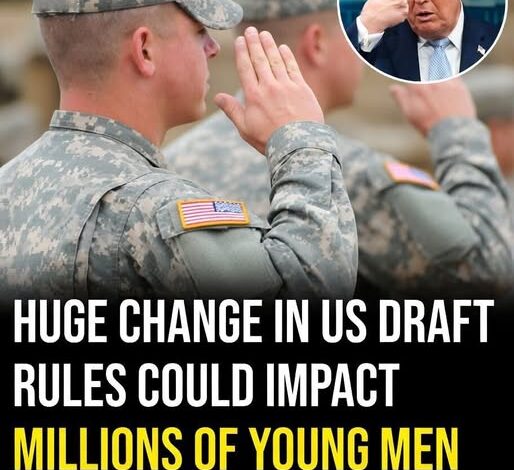
A quiet but consequential shift is taking shape in the United States—one that could affect millions of young men without them ever filling out a form or even realizing it in the moment. The Selective Service System, long dependent on individual compliance, is moving toward an automatic registration model that would fundamentally change how eligibility for a potential military draft is recorded. For generations, men between 18 and 25 have been legally required to register themselves. Under the new approach, that responsibility would no longer rest on the individual. Instead, the federal government would handle enrollment behind the scenes, pulling data from existing systems to ensure nearly everyone who qualifies is registered by default.
This change is expected to take effect by December 2026 and is tied to provisions within the National Defense Authorization Act (NDAA) for that year—a major legislative package that outlines defense priorities and funding. By embedding the policy in a broader, must-pass bill, lawmakers effectively streamlined its path forward, avoiding the kind of public spotlight that often accompanies standalone legislation. Supporters frame the move as a practical upgrade. Registration rates, while still relatively high, have shown a gradual decline in recent years, and officials worry that even small gaps could become significant in a crisis. Automating the process, they argue, ensures consistency, reduces administrative costs, and eliminates the need for outreach campaigns reminding young men to comply with the law.
Under the current system, failing to register can carry serious consequences, at least on paper. Penalties can include hefty fines, possible prison time, and ineligibility for federal student aid, certain jobs, and immigration benefits. In reality, enforcement has been uneven, and prosecutions are rare. The new system sidesteps that inconsistency entirely. By registering individuals automatically—likely using information from agencies such as the Social Security Administration—the government removes the possibility of noncompliance. It’s a shift from obligation to automation, one that promises efficiency but also raises important questions about data use and oversight.
Context matters here. While officials insist there are no immediate plans to reinstate a draft, the Selective Service system exists as a contingency, a kind of dormant infrastructure meant to be activated only in extreme circumstances. At a time of rising global tensions and unpredictable geopolitical shifts, some see this update as a logical step to keep that system current. Others interpret it as a sign that policymakers are thinking more seriously about worst-case scenarios, even if they aren’t publicly committing to them.
Public response reflects that divide. Advocates of the change view it as modernization—bringing an outdated, manual process into alignment with how government systems already function in other areas. Critics, however, worry about what’s lost when participation becomes invisible. If individuals are registered without taking action, does that reduce awareness of what the system represents? Does it create distance between citizens and the responsibilities tied to national defense? There are also concerns about transparency—whether people will be clearly informed that they’ve been enrolled, and how their data is being used in the process.
At a deeper level, the shift speaks to a broader evolution in how government interacts with its citizens. Automation can increase efficiency, but it also changes the nature of consent and participation. In this case, millions of young men would become part of a national readiness system not through a deliberate choice, but through a background process they may never see.
Whether this change ultimately proves to be a minor administrative tweak or a signal of something more significant will depend on how it’s implemented—and what comes next. For now, it stands as a notable recalibration of a long-standing policy, one that blends practicality with uncertainty. As the 2026 deadline approaches, the conversation is likely to expand, raising questions not just about military preparedness, but about how much of civic responsibility should be automated—and at what cost.