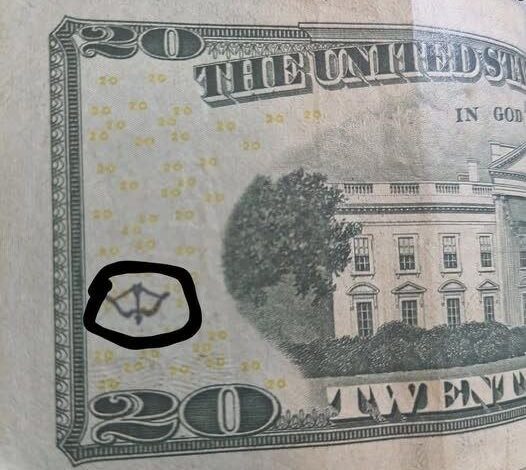
Every now and then, something as ordinary as a paper bill can spark a wave of curiosity. A tiny imperfection, barely noticeable at first glance, suddenly becomes the center of attention—shared, debated, and examined under magnification. Lately, collectors and casual observers alike have been talking about a particular $20 bill that appears to carry an unusual mark near the image of the White House. It’s subtle, easy to miss if you’re not looking for it, but once you see it, it’s hard to ignore.
What draws people in isn’t just the mark itself—it’s the possibility behind it. Paper currency is produced in enormous quantities, with precision and speed that leave little room for variation. But no process is perfect. Every so often, a sheet passes through with a slight flaw: a smear of ink, a shift in alignment, a detail printed where it shouldn’t be. Most of these go unnoticed in everyday circulation, but a few catch the right eye at the right time—and that’s when they become something more.
In this case, the mark reportedly appears just to the left of the White House engraving, sometimes blending into the background pattern or sitting awkwardly near the “20” design elements. Some believe it’s the result of a printing plate defect, others think it could be an ink bleed or transfer error during production. Whatever the cause, it’s not part of the intended design—and that’s exactly what makes it interesting.
To collectors, these imperfections are not flaws; they’re signatures. Each error tells a small story about how the bill was made, a moment where the system slipped just enough to create something unique. And in a world where most currency is identical, uniqueness carries value. The more distinct and well-preserved the error, the more desirable it becomes. In some cases, bills with clear, rare printing mistakes have sold for far more than their face value—sometimes hundreds or even thousands of dollars.
But not every odd mark guarantees a payday. Condition plays a huge role. A crisp, uncirculated bill with a clear, unmistakable error will always attract more interest than one that’s been folded, worn, or faded. Serial numbers can also add another layer of value—low numbers, repeating patterns, or unusual sequences can increase a bill’s appeal even further.
What’s fascinating is how easily something like this can pass through our hands without a second thought. A bill gets folded into a wallet, handed over at a store, or tucked into a drawer—never realizing it might be different. It’s a reminder that value isn’t always obvious at first glance. Sometimes it’s hidden in the smallest details, waiting for someone curious enough to look a little closer.
So if you ever come across a $20 bill that seems slightly “off”—a strange symbol, a doubled print, a misaligned design—it might be worth pausing before you spend it. Take a closer look. Compare it to a standard bill. And if it truly stands out, consider having it evaluated by a professional who understands currency grading and error classification.
Because every once in a while, something ordinary turns out not to be ordinary at all. And in those rare moments, a simple piece of paper can carry a story—and a value—far greater than the number printed on its corner.